The ability to develop others by facilitating their learning, growth, and problem-solving through active listening, powerful questioning, and supportive dialogue. It involves empowering individuals to find their own solutions, focusing on both performance improvement and long-term development while building trust, clarity, and accountability.
“Coaching is unlocking a person’s potential to maximise their own performance. It is helping them to learn rather than teaching them.” – Sir John Whitmore
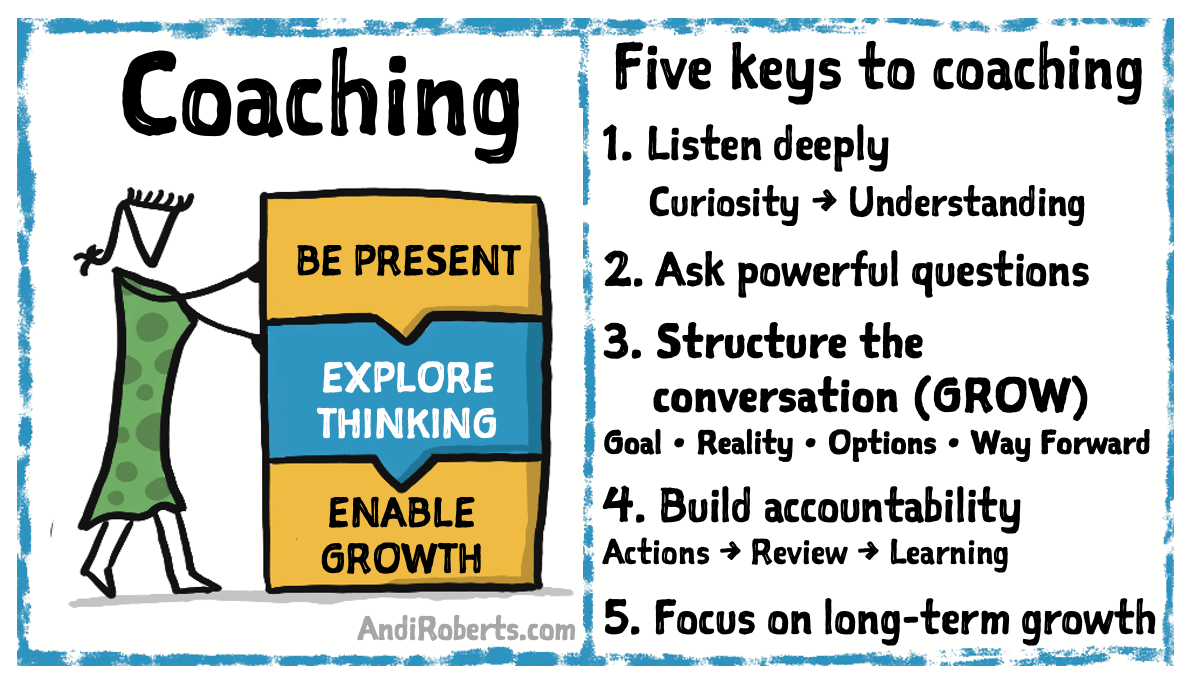
The diagram above summarises the five practical behaviours that help leaders lead with coaching at work.
Why coaching matters
Coaching matters because it directly drives individual and team capability while embedding a culture of continuous learning. Leaders who coach well create the conditions for people to develop critical thinking, resilience, and problem-solving skills. It strengthens engagement, enhances performance, and ensures that knowledge and expertise are distributed rather than concentrated in a few individuals, making teams more agile and effective in complex, changing environments.
Without effective coaching, teams rely heavily on the leader for direction, slowing decision-making and limiting growth. Opportunities for innovation and skill development are missed, and employees may disengage. Strong coaching enhances adaptability, builds follower-ship, and fosters trust, enabling leaders to cultivate high-performing teams who take ownership of their own development while increasing the leader’s credibility and impact.
“What great coaches do is help people see what they can be, not just what they are.” – Bill Bradley
What good and bad look like in coaching
| What bad looks like | What good looks like |
|---|---|
| Talks more than listens, providing answers rather than exploring the team member’s perspective. | Listens actively, giving space for employees to reflect and respond, uncovering insights. |
| Focuses exclusively on correcting poor performance, neglecting strengths and potential. | Balances performance management with development, nurturing both capabilities and potential. |
| Avoids coaching due to time pressures, prioritizing immediate tasks over growth. | Integrates coaching into daily work, treating development as a core responsibility. |
| Uses a one-size-fits-all approach, failing to adapt to individual learning styles. | Tailors coaching style to the individual, recognizing preferences and motivations. |
| Provides feedback only when issues arise, often in public or reactive settings. | Gives regular, timely, and balanced feedback that recognizes achievements and guides improvement. |
| Expects employees to solve problems without guidance, or conversely, solves problems for them. | Guides employees to find their own solutions through questioning and reflection. |
| Fails to follow up after coaching sessions, leaving goals unclear. | Sets clear goals and regularly checks in, providing support and accountability. |
| Relies solely on personal expertise, avoiding learning or feedback on coaching skills. | Invests in personal development as a coach, continuously refining their approach. |
“A leader is one who knows the way, goes the way, and shows the way.” – John C. Maxwell
Barriers to coaching
Lack of time: Effective coaching requires consistent effort and regular check-ins, which some leaders find difficult to prioritise over immediate responsibilities. In the face of mounting workloads and urgent deadlines, the perceived luxury of a developmental conversation often takes a back seat to operational firefighting. However, by failing to dedicate time to the growth of their team, leaders inadvertently trap themselves in a cycle of dependency where they remain the sole engine of productivity.
Short-termism: Coaching is a long-term investment in human capital. Leaders under intense pressure to deliver quick results may shy away from it because they do not see an immediate payoff for their efforts. This focus on the current quarter or the next milestone overlooks the reality that sustainable performance is built through gradual capability building. Without a shift toward a long-term perspective, the team remains stagnant while the leader pursues fleeting, immediate gains.
Unsure how to coach: Some leaders confuse coaching with giving directives, missing the opportunity to guide employees toward their own solutions. This lack of technical skill often results in a “tell” rather than “ask” approach, which shuts down critical thinking and limits the individual’s ability to navigate future challenges independently. Professional development is hindered when a leader lacks the specific frameworks or questioning techniques required to facilitate true discovery.
Control freaks and perfectionists: Coaching requires stepping back and allowing team members to experiment and make mistakes, which can be hard for those who prefer total control. For leaders with a perfectionist streak, the risk of a suboptimal outcome is seen as a personal failure rather than a necessary part of the learning curve. This rigid oversight prevents the team from developing the resilience and initiative needed to handle complex tasks without constant supervision.
Low trust: A lack of confidence in a team’s abilities can prevent leaders from delegating responsibility or empowering development. If a leader believes that their staff are incapable of meeting standards, they will avoid the very coaching conversations that could bridge that gap. This becomes a self-fulfilling prophecy where the team never improves because they are never given the space or the trust required to prove their competence.
Low self-confidence: Without formal training, some leaders doubt their own ability to guide others effectively and avoid coaching conversations altogether. This internal hesitation often stems from a fear of being asked a question they cannot answer or an anxiety about managing the emotional nuances of a development session. Rather than risking a perceived loss of authority, these leaders stick to safer, more transactional management tasks.
Problem-focused: Many leaders view coaching only as a corrective tool for poor performance, rather than a way to nurture high-performing talent. When development is framed exclusively as a remedy for failure, it carries a negative stigma that makes employees defensive. A more effective approach involves coaching everyone, ensuring that even the strongest performers are stretched and supported to reach their full potential.
Inconsistency: Leaders may abandon coaching efforts if they do not see immediate results, failing to provide the sustained commitment required for behavioural change. Real growth is rarely linear and often requires multiple sessions to embed new habits or mindsets. When a leader starts and stops their coaching initiatives, it creates confusion and signals to the team that their development is not a genuine priority.
Wedded to expertise: Transitioning from being the expert with solutions to the coach with questions can be a significant identity challenge. Many leaders have built their entire careers on being the person who knows the answer, and they may feel that their value is diminished if they are not solving problems directly. Learning to find value in the success of others rather than in their own technical brilliance is a major hurdle for many senior professionals.
Poor boundary management: Blurring the lines between coaching and traditional management often leads to micromanagement. When a leader fails to distinguish between a developmental space and a performance review, the employee may feel monitored rather than supported. Maintaining clear boundaries ensures that the coaching environment remains safe for vulnerability, which is essential for genuine growth and honest reflection.
“The power of coaching is this, you are expected to give people the path to find answers, not the answers.” – Tom Mahalo
Enablers of coaching
Listen actively: Effective coaching begins with the discipline of listening more than one speaks. By focusing entirely on understanding the speaker rather than simply waiting for a turn to respond, a leader can identify the subtle motivations and underlying challenges that often go unspoken. This level of deep listening builds a bridge of respect, ensuring the team member feels truly heard and valued.
Ask powerful questions: The hallmark of a great coach is the ability to use open-ended and thought–provoking questions that stimulate discovery. Instead of providing the solution, a leader should pose inquiries that encourage individuals to think critically and explore new perspectives. This shift from telling to asking prompts self-reflection essential for genuine intellectual and professional growth.
Be holistic: To be truly effective, a leader must shift their focus from merely managing immediate performance to fostering long-term development. This requires looking beyond the tasks of the current week to consider the broader capabilities an individual needs for their future career. By adopting this wide-angle lens, coaching becomes a strategic tool for building enduring talent rather than a tactical fix for minor issues.
Create psychological safety: Effective coaching thrives in an environment where trust and rapport are the foundation. When team members feel psychologically safe, they are far more likely to be honest about their goals, fears, and mistakes without the worry of being judged. This safety allows for a more authentic dialogue, which is necessary for uncovering the real barriers to an individual’s progress.
Create clarity: Collaborating with team members to define specific and realistic goals ensures that everyone is moving in the same direction. Without this clarity, coaching conversations can become aimless or confusing, leading to a lack of progress. By establishing clear milestones and expectations together, the leader provides a roadmap that makes the development process feel tangible and achievable.
Raise your zen: Patience and persistence are vital qualities for any leader who wishes to see meaningful change in their team. Development is rarely an overnight success and often involves setbacks or periods of slow progress. By remaining calm and consistent in their support, a leader demonstrates a commitment that encourages the team member to keep persevering through the more difficult stages of their learning.
Empower: The primary objective of coaching is to guide team members toward finding their own answers rather than relying on the leader for every decision. This approach helps individuals take full ownership of their learning and builds their confidence in their own problem solving abilities. Empowerment shifts the dynamic from one of dependency to one of self-sufficiency and initiative.
Balance your feedback: To maintain high levels of motivation, a leader should combine constructive criticism with genuine positive reinforcement. If feedback is exclusively negative, it can lead to disengagement, whereas if it is exclusively positive, it may fail to drive any real improvement. A balanced approach ensures that the individual understands their strengths while remaining clear on the areas that require further effort.
Raise your self-awareness: A coach must be willing to reflect on their own tendencies and personal biases to ensure they are providing the best support possible. Understanding how one’s own personality or past experiences might influence a coaching session allows for a more objective and adaptive approach. This internal work is what prevents a leader from projecting their own preferences onto the person they are trying to help.
Keep growing: The best coaches are those who recognise that their own learning is never complete. By investing in their own development through professional courses, regular reading, or seeking feedback from peers, leaders can continuously refine their technique. This commitment to personal growth not only improves their effectiveness but also sets a powerful example of lifelong learning for the entire team.
“Coaches and the people they coach know that for the future to be different, we need to change the way we do things in the present.” – Gary Collins
Reflection questions on coaching
Who in your world are good role models as coaches? What could you learn from them?
How would you describe your current approach to coaching within your team? How could you improve it?
What challenges do you face when trying to coach? How can you reduce them over time?
In recent conversations, how much time did you spend listening versus talking?
How do you ensure coaching sessions are collaborative rather than directive?
Do you balance immediate performance needs with long-term development goals?
Do you adapt your approach to the unique learning styles of different team members?
How do you encourage a growth mindset within your team?
How do you follow up to ensure progress and maintain accountability?
What steps can you take to improve your own coaching skills?
Do you have a coach yourself? How would having one help you grow?
“The manager needs to have a coaching mindset, looking for opportunities to help others learn.” – James M. Hunt
Micro practices in coaching
Lead with “What” and “How”: Replace advice with open questions to force a shift from passive listening to active discovery. Use specific prompts such as “What is the primary obstacle here?” or “How would you solve this if you had total autonomy?” to trigger critical thinking. This direct approach removes the leader as the bottleneck for solutions and places the responsibility for problem-solving firmly with the team member.
Apply the five second silence: Wait for a full five seconds after a team member finishes speaking before you offer any input. This deliberate silence acts as a prompt for the coachee to fill the gap with deeper reflections or hidden concerns. By mastering this pause, you ensure that you are responding to the full picture rather than reacting to the first thing they say.
Contract for specific milestones: Agree on exactly what progress looks like by co-signing specific and measurable milestones. Move away from vague development goals and instead define clear indicators of success that both parties can track. This creates a professional contract of sorts that ensures the coachee knows exactly what they are aiming for and how their growth will be assessed.
Audit the “Safe to Fail” zone: Identify specific low-risk tasks where you can give the team member total creative control and permission to fail. Once the task is complete, conduct a rapid debrief focused entirely on the lessons learned rather than the result itself. This practice systematically builds resilience and encourages the initiative required for independent high performance.
Close with an accountability loop: End every coaching interaction by asking the coachee to summarise their own next steps and the deadline for completion. Schedule a brief follow-up check-in immediately to review these actions and remove any emerging blockers. This creates a relentless focus on tangible results and ensures that developmental conversations lead to actual changes in behaviour or output.
“The delicate balance of mentoring someone is not creating them in your own image, but giving them the opportunity to create themselves.” – Steven Spielberg
Explore related leadership resources
To further develop this capability, examine how it intersects with other core leadership dimensions across the libraries:
Leadership library:
- Listening: Master the foundational skill required to hear what is said and unsaid so you can understand a team member’s true perspective.
- Developing others: Align your coaching with the broader strategic commitment to building long-term capability and bench strength across the organisation.
- Sizing people up: Accurately assess an individual’s potential and readiness so you can tailor your coaching approach for maximum impact.
Supporting libraries
- Empathy (Traits): Leverage the natural inclination to connect with the feelings of others to form the essential emotional foundation of a coaching relationship.
- Positive view of people (Traits): Adopt the core belief that individuals are capable of growth which is necessary to let go of control and empower others.
- Emotional self-awareness (EQ-i): Recognise your own emotional triggers to remain objective and supportive even during challenging or high-pressure coaching moments.
Continue exploring: Return to the Leadership Library to view the full directory of competencies and resources.
Want to develop others through better coaching, not just advice?
For You: Leadership Clinic
Bring one coaching conversation you are unsure how to approach. I prepare beforehand, then we spend 90 focused minutes working it through together. One challenge, one session, no ongoing commitment.
For You: Executive Coaching
Really looking to build your coaching capability as a leader? Work with me over time to sharpen your listening, ask more powerful questions and develop the people around you.
For Your Organisation: Leadership development
I can help build coaching capability in your leaders through a shorter masterclass, a longer deeper dive, or by weaving it into a broader, multi-topic leadership journey. These can run online, face to face or hybrid.
Choose the level of support that fits what you are working through.