The capacity to lead and stay connected across distance, ensuring alignment and trust in a distributed world. It involves keeping people informed, bridging gaps between headquarters and the field, and maintaining strong relationships despite geographical, cultural, or hybrid barriers. Leaders who excel in connectivity create cohesion across boundaries, making distance feel smaller and collaboration stronger.
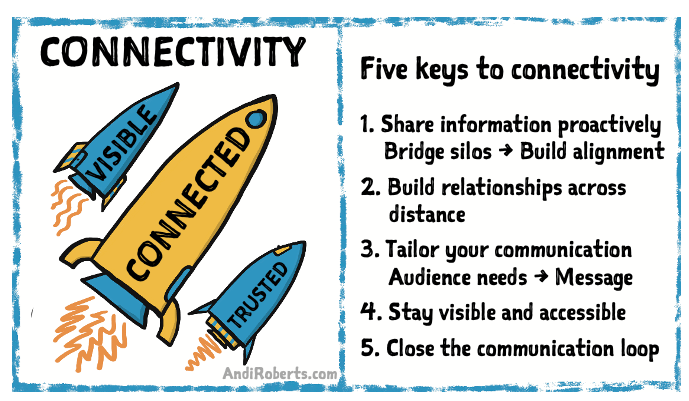
The connectivity visual above summarises five practical behaviours that help leaders stay connected across boundaries and distance: sharing information proactively, building relationships across distance, tailoring communication to the audience, staying visible and accessible, and closing the communication loop.
“The art of communication is the language of leadership.” James Humes
Why connectivity matters
Connectivity matters because modern organisations increasingly operate across distance, whether through global offices, field-based teams, or hybrid working arrangements. Leaders who maintain strong connectivity ensure that distributed teams stay aligned with strategy, informed of decisions, and connected to the wider organisation despite physical separation. This capability closes the gap between headquarters and the field, prevents duplicated effort, and ensures that critical information travels quickly and accurately in both directions. In organisations where teams rarely share the same room, connectivity becomes the thread that holds collective effort together.
When connectivity is weak, distance quickly becomes distance in every sense: teams feel forgotten, decisions are made without important context, and trust erodes as silence is filled with assumption. Remote or field-based colleagues can begin to feel like an afterthought, which weakens engagement and increases the risk of misalignment with organisational priorities. Leaders who invest in connectivity counter this by staying visible, communicating proactively, and building relationships that do not depend on physical proximity. This strengthens organisational cohesion, protects trust across boundaries, and ensures that geography never becomes an excuse for disconnection.
“The single biggest problem in communication is the illusion that it has taken place.” George Bernard Shaw
What good and bad connectivity looks like
| What bad looks like | What good looks like |
|---|---|
| Shares information sporadically or only when directly asked, leaving colleagues and headquarters to piece together context from incomplete updates. This creates duplication of effort as people unknowingly repeat work or make decisions without full visibility. Over time, the silence is read as guardedness, and trust in the leader’s transparency begins to erode. | Shares relevant information proactively and consistently, ensuring that both headquarters and distributed teams operate from the same picture. Updates are timely and pitched at the right level of detail for each audience, reducing duplication and confusion. This steady flow of information signals reliability and keeps collaboration moving smoothly across distance. |
| Avoids engaging with senior stakeholders unless a specific issue forces the conversation, treating upward communication as an occasional obligation rather than an ongoing relationship. This limits the leader’s visibility, reduces opportunities to shape decisions, and leaves senior colleagues with a thin understanding of what is really happening on the ground. Over time the leader becomes an unknown quantity to those who could otherwise champion their work. | Builds a rhythm of proactive engagement with senior management, sharing context, progress, and challenges before being asked. This visibility creates opportunities to influence decisions early and ensures that senior stakeholders understand the realities of distributed or field-based work. The relationship becomes a two-way channel rather than a reactive one, strengthening trust in both directions. |
| Concentrates almost entirely on local priorities, treating the wider organisational context as background noise rather than something to actively track. Decisions are made with a narrow field of view, which can create friction when local choices conflict with broader strategy. Colleagues elsewhere in the organisation begin to see the leader as disconnected from the bigger picture. | Balances attention to local realities with a genuine understanding of organisational strategy and priorities. Decisions are explained in terms of how they serve both the immediate context and the wider goals, helping local teams see themselves as part of something larger. This dual awareness makes the leader a credible bridge between the field and the centre. |
| Applies a single communication style regardless of the audience, overlooking cultural norms around hierarchy, directness, or formality. This can create discomfort or confusion for colleagues from different backgrounds, who may interpret the same message very differently than intended. Over time, this erodes rapport and makes cross-cultural collaboration harder than it needs to be. | Actively adapts tone, pace, and format to the cultural context of each audience, showing genuine curiosity about how different groups prefer to communicate. This flexibility helps messages land as intended and signals respect for the people receiving them. Colleagues across cultures feel understood, which strengthens both trust and the quality of collaboration. |
| Relies on outdated or inconsistent tools, or uses collaboration technology poorly, so updates arrive late, get lost, or fail to reach the right people. Meetings across time zones are scheduled without consideration for those most inconvenienced, quietly signalling whose time matters more. Distance becomes a daily source of friction rather than something technology has helped to close. | Uses collaboration platforms deliberately and thoughtfully, choosing the right channel for the right message and being mindful of time zones and working patterns. Technology is treated as a tool for building genuine connection, not just transmitting information, with effort made to keep interactions feeling personal despite the distance. This thoughtful use of tools makes remote collaboration feel dependable rather than makeshift. |
| Shares good news readily but becomes vague or evasive when challenges or setbacks arise, leaving stakeholders to sense that something is being withheld. This selective transparency undermines credibility, since people quickly learn that positive updates cannot be taken entirely at face value. Trust weakens precisely when it is needed most, during difficult or uncertain periods. | Communicates openly about both progress and setbacks, giving stakeholders an honest and complete picture even when the news is difficult. This consistency builds a reputation for reliability, so that when the leader does report good news, it is trusted without question. Transparency during hard moments often does more to build trust than any amount of good news. |
| Treats communication as a transactional obligation, focused narrowly on tasks and status updates rather than genuine relationship-building. Interactions feel functional rather than personal, which limits the depth of trust that can form across distance. Colleagues may comply with requests but rarely feel genuinely connected to the leader or invested in their success. | Invests time in building real relationships alongside task-focused communication, taking a genuine interest in colleagues’ experiences and challenges. This deeper connection makes people more willing to raise concerns early, offer honest feedback, and go beyond what is strictly required. Distance feels smaller when the relationship behind the communication is strong. |
| Communicates with senior stakeholders and distributed teams in largely the same way, without taking time to understand what each audience actually needs to know or cares most about. Messages can feel generic or poorly targeted, requiring extra effort from the receiver to extract what matters to them. This creates friction and reduces the impact of otherwise useful information. | Takes time to understand the priorities, pressures, and preferred style of each key stakeholder, then tailors communication accordingly. Messages are pitched to be immediately useful and relevant, which increases the likelihood they are read, understood, and acted upon. This targeted approach makes the leader’s communication consistently valuable rather than just frequent. |
“The most important thing in communication is hearing what isn’t said.” Peter Drucker
Barriers to connectivity
Withholding information: Some leaders fail to keep colleagues or headquarters informed, creating mistrust and duplication of effort. Over time, silence erodes credibility and leaves others questioning commitment.
Overconfidence in independence: Believing they know best, leaders may act without consulting others. This isolates them from organisational priorities and undermines collective progress.
Narrow focus: Concentrating only on local operations or immediate work blinds leaders to the wider organisational context. This tunnel vision makes it difficult to align with shared goals.
Reluctance to engage upwards: Leaders who avoid interacting with senior management miss opportunities to influence and to gain vital context. This can make them appear disconnected or uncommitted.
Fear of mistakes: Anxiety about being judged may stop leaders from sharing updates or seeking advice. The result is limited communication and missed opportunities for support.
Low confidence: Leaders unsure of their standing may hesitate to reach out to key stakeholders. This hesitancy weakens visibility and reduces trust in their leadership.
Cultural discomfort: In global or hybrid contexts, some leaders struggle to navigate cultural differences. Avoiding engagement across cultures reduces the flow of ideas and collaboration.
Defensiveness: Leaders who feel scrutinised by headquarters may respond by withholding information. This creates barriers instead of building bridges.
Technology gaps: Poor use of digital tools or reliance on outdated methods hinders communication. Without effective channels, distance becomes a daily obstacle.
Transactional mindset: Leaders who treat communication as a tick-box task, rather than as relationship-building, limit the depth of connection. This reduces engagement and weakens alignment.
“Leadership is about making others better as a result of your presence, and making sure that impact lasts in your absence.” Sheryl Sandberg
Enablers of connectivity
Leverage technology effectively: Use collaboration platforms to bridge time zones and distance. Thoughtful use of tools ensures communication feels immediate and reliable.
Develop strong communication skills: Hone the ability to write clearly, speak with impact, and adapt tone across different audiences. Effective communication builds trust and visibility.
Stay consistently connected: Keep regular contact with stakeholders through updates, calls, and informal check-ins. Consistency prevents isolation and demonstrates reliability.
Tailor your style: Adapt communication to the needs of different groups and cultures. Flexibility signals respect and ensures your messages land as intended.
Inform the right people: Make sure information reaches those who most need it, not just your immediate circle. Sharing broadly avoids silos and strengthens collaboration.
Communicate openly: Offer honest updates, even on challenges or setbacks. Transparency builds credibility and fosters mutual trust.
Know your stakeholders: Take time to learn the priorities, pressures, and styles of key decision-makers. Understanding them helps you position your messages more effectively.
Learn how the system works: Study organisational processes and decision flows. Knowing who influences what allows you to connect at the right time and place.
Keep up with trends: Stay informed about developments in your industry and organisation. Sharing relevant insights makes your communication valuable and future-focused.
Maintain transparency: Balance good news with realistic updates. Leaders who share openly are seen as trustworthy and dependable partners.
“Leadership is the art of giving people a platform for spreading ideas that work, across boundaries and borders.” Seth Godin
Reflection questions on connectivity
How regularly do you share updates with key stakeholders, and do they feel well-informed? What more could you do to make your communication timely and relevant?
When have you acted independently without checking alignment, and what impact did it have? How could involving others earlier have changed the outcome?
How do you balance local priorities with wider organisational goals? Do your colleagues feel you give equal weight to both?
Do you make time to build relationships with senior management, or only when required? How might stronger proactive relationships shift their perception of you?
How does fear of making mistakes affect the way you communicate? Do you hold back information that might actually build trust if shared openly?
Do you project confidence when engaging across the organisation, even in uncertain situations? What signals could you send to appear more grounded and credible?
How well do you adapt your communication across different cultures and contexts? What practices help you show respect and understanding in diverse settings?
Do you use digital tools to strengthen your connections with others, or do they sometimes create more distance? How could you make your use of technology feel more personal and engaging?
How much of your communication is transactional, and how much builds real relationships? What small steps could shift more of your interactions toward trust-building?
Do you consistently share both successes and challenges to maintain transparency and trust? How might greater openness change the way others respond to you?
“Communication works for those who work at it.” John Powell
Micro practices for connectivity
1. Send a weekly connection update: Set a recurring cadence, weekly or fortnightly, for sharing a short update with key stakeholders covering progress, challenges, and what is coming next. Keep it brief and consistent rather than long and occasional. Predictable updates build trust and reduce the anxiety that silence often creates across distance.
2. Schedule proactive check-ins with senior stakeholders: Rather than waiting to be summoned, initiate short, regular conversations with senior management to share context and surface issues early. Come prepared with one or two specific points worth their attention. This visibility strengthens the relationship and positions you as a reliable source of ground-level insight.
3. Adapt one message for two audiences: When sharing an update that matters to both headquarters and the field, take a few extra minutes to reframe it for each audience rather than sending an identical message to both. Highlight what is most relevant to each group’s priorities. This small effort of translation makes communication land more effectively on both sides.
4. Name what technology cannot convey: Before a remote meeting or message, consider what nuance, tone, or context might get lost without in-person cues, and address it explicitly. A brief acknowledgement that a message is time-sensitive or informal can prevent misreadings that are common across distance. This habit reduces the misunderstandings that silence and screens can create.
5. Close the loop on difficult updates: After sharing challenging news or a setback, follow up within a few days to check how it landed and answer any lingering questions. Do not let difficult updates sit unaddressed simply because the conversation felt uncomfortable. This follow-through demonstrates that transparency is genuine, not just a one-off disclosure.
“Alone we can do so little; together we can do so much.” Helen Keller
Explore related leadership resources
To further develop this capability, examine how it intersects with other core leadership dimensions across the libraries:
Leadership library:
- Informing Others: Ensure a consistent flow of information that bridges the gap between headquarters and the field, keeping distributed teams aligned and empowered.
- Collaboration (Fostering): Create the digital and cultural infrastructure needed for people to work together seamlessly, regardless of their physical location.
- Interpersonal Savvy: Navigate complex social dynamics and cultural nuances to build strong, effective relationships across geographical boundaries.
- Lateral Leadership: Influence and lead across departmental lines without formal authority, which is essential for maintaining cohesion in hybrid environments.
Supporting libraries
- Inclusivity (Traits): Actively ensure that remote or “field” team members feel as valued and heard as those in the central office, preventing a “two-tier” culture.
- Positive view of people (Traits): Maintain a fundamental trust in your team’s capabilities and intentions, which is the cornerstone of successful remote management.
- Social responsibility (EQ-i): Demonstrate a commitment to the greater good of the collective community, fostering a shared sense of purpose that transcends distance.
Continue exploring: Return to the Leadership Library to view the full directory of competencies and resources.
Want to keep your distributed team genuinely connected, not just informed?
For You: Leadership Clinic
Bring one relationship or team that has drifted since you started working apart. I prepare beforehand, then we spend 90 focused minutes working it through together. One challenge, one session, no ongoing commitment.
For You: Executive Coaching
Really looking to strengthen connectivity across your team? Work with me over time to build alignment and trust across distance and bridge the gaps between headquarters and the field.
For Your Organisation: Leadership development
I can help strengthen connectivity across distributed teams through a shorter masterclass, a longer deeper dive, or by weaving it into a broader, multi-topic leadership journey. These can run online, face to face or hybrid.
Choose the level of support that fits what you are working through.