The ability to generate new ideas and approaches to solve problems, improve processes, or seize opportunities. This competency involves thinking beyond traditional solutions, encouraging experimentation, and drawing on diverse perspectives to drive innovation and adaptability in a changing environment.
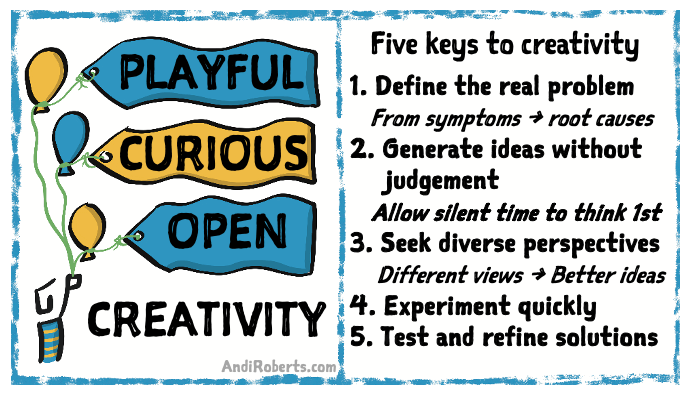
The creativity visual above summarises five practical behaviours that help leaders generate and develop better ideas: defining the real problem, generating ideas without judgement, seeking diverse perspectives, experimenting quickly, and testing and refining solutions.
“Creativity is not a talent. It is a way of operating.” John Cleese
Why creativity matters
Creativity matters because organisations that keep solving the same problems with the same methods eventually stagnate, even as their environment continues to change. Leaders who generate new ideas and encourage inventive thinking open up better solutions, spot opportunities others miss, and keep their organisations adaptable in the face of disruption. This capability turns constraints into starting points rather than dead ends, and it allows teams to approach recurring problems with fresh eyes instead of defaulting to familiar routines. In competitive or fast-changing markets, creativity is frequently what separates organisations that shape their future from those that are shaped by it.
Without creativity, teams default to the safest and most familiar option, even when it no longer serves the problem at hand. Innovation stalls, opportunities are missed, and organisations become vulnerable to competitors or disruptions that demand a different way of thinking. Leaders who cultivate creativity build cultures where experimentation is welcomed, diverse perspectives are actively sought, and failure is treated as useful information rather than something to be avoided. This strengthens the organisation’s long-term adaptability and ensures that good ideas are not lost simply because they fall outside conventional thinking.
“The enterprise that does not innovate ages and declines. And in a period of rapid change such as the present, the decline will be fast.” Peter Drucker
What good and bad creativity looks like
| What bad looks like | What good looks like |
|---|---|
| Defaults to solutions that worked in the past, applying them to new problems without questioning whether the underlying context has changed. This reliance on precedent can feel efficient in the short term, but it often produces answers that no longer fit the situation. Over time, the team’s thinking narrows to a fixed set of familiar responses, and genuinely new problems are forced into old frameworks that were never designed for them. | Treats past solutions as one input among many rather than the automatic answer, actively asking whether the current problem calls for a different approach. This openness allows the team to recognise when familiar methods no longer apply and to build something better suited to the situation. Over time, this habit keeps the team’s thinking current and prevents the organisation from solving tomorrow’s problems with yesterday’s tools. |
| Avoids untested ideas out of fear that they might fail publicly or reflect poorly on the leader’s judgement, favouring safe and predictable choices instead. This caution can feel responsible in the moment, but it steadily narrows the range of solutions the team is willing to consider. Promising ideas are dismissed before they are even explored, simply because they carry some uncertainty. | Creates space for untested ideas to be explored through small, low-risk experiments rather than dismissing them outright. This willingness to test rather than reject allows genuinely useful ideas to surface, even when they initially seem uncertain or unconventional. The team learns that measured risk-taking is expected and valued, which steadily increases the volume and quality of ideas put forward. |
| Approaches problems using a narrow set of perspectives, often drawn from the same function, background, or level of seniority. This limits the range of ideas generated and increases the likelihood that blind spots go unnoticed until they cause real problems. Diverse input is treated as a nice-to-have rather than something actively sought out. | Deliberately seeks input from people with different backgrounds, functions, and experience levels before settling on an approach. This diversity of perspective surfaces angles on the problem that a single viewpoint would have missed entirely. Involving people from outside the immediate team also builds broader ownership of the eventual solution. |
| Dismisses ideas too quickly for being impractical or unconventional, cutting off exploration before the idea has had a chance to develop. This instinct to filter for practicality early can quietly eliminate the most promising ideas before their potential is understood. Over time, the team learns to self-censor, offering only safe suggestions rather than genuinely creative ones. | Allows impractical or unconventional ideas room to develop before evaluating their feasibility, recognising that early judgement often kills good ideas prematurely. This patience creates psychological safety for people to suggest bolder options without fear of instant dismissal. Practicality is still applied, but later in the process, once the idea has been fully explored. |
| Introduces judgement or criticism too early in group discussions, causing people to filter their contributions or stop offering ideas altogether. This instinct to evaluate immediately shuts down the free flow of thinking that creative problem-solving depends on. Sessions intended for idea generation quickly collapse into premature debate about feasibility. | Separates idea generation from evaluation, encouraging free and unfiltered contribution before any judgement is applied. This structure gives people confidence to share half-formed or unusual ideas, which often spark better ones from others in the room. Evaluation still happens, but only once the full range of possibilities has been captured. |
| Jumps straight to solutions without fully understanding the underlying problem, resulting in fixes that address symptoms rather than root causes. This haste can produce fast answers that later turn out to be the wrong ones, requiring rework and eroding confidence in the process. Time pressure is often used as the justification for skipping this step. | Invests time upfront to clearly define the problem and understand its root causes before generating solutions. This discipline increases the likelihood that the eventual solution actually addresses what is driving the issue, rather than merely treating its symptoms. Though it can feel slower initially, it typically saves significant time and rework later. |
| Treats failed experiments as evidence that an idea was not worth pursuing, discouraging further attempts and reinforcing a culture of caution. This response to setbacks teaches people to avoid experimentation altogether rather than to learn from what did not work. Genuinely promising ideas are abandoned after a single unsuccessful trial. | Treats failed experiments as valuable information that sharpens the next attempt, reinforcing that useful learning often comes from what does not work. This mindset encourages the team to keep testing and iterating rather than abandoning ideas after one setback. Small, low-cost failures become an accepted and expected part of the innovation process. |
| Positions the leader as the sole source of new ideas, expecting to personally solve creative challenges rather than drawing on the team. This concentrates creative output in one person and leaves valuable perspectives from others untapped. It also creates a bottleneck, since progress depends entirely on the leader’s own capacity for original thinking. | Actively involves others in generating and shaping ideas, treating creativity as a shared team capability rather than a personal trait to be demonstrated. This distributes the creative workload, surfaces a wider range of ideas, and builds the team’s collective confidence in their own inventive ability. The leader’s role shifts from sole idea generator to facilitator of the team’s creativity. |
“There is no such thing as a new idea. We simply take a lot of old ideas and put them into a sort of mental kaleidoscope.” Mark Twain
Barriers to creativity
Stuck in the past: Leaders may rely heavily on past experiences and solutions, resisting new ideas and innovations.
Excessively cautious: Fear of failure and risk aversion prevents some leaders from exploring creative and unconventional approaches.
Lack of understanding: Leaders may not fully grasp what creativity entails or how to foster it within their teams.
Limited thinking: Some leaders’ thought processes are often constrained to traditional methods and established practices.
Narrow perspective: A limited and narrow outlook, possibly due to a narrow background, may restrict a leader’s ability to see beyond the obvious.
Overly practical: A strong focus on practicality can lead leaders to dismiss creative ideas as impractical or fanciful.
Reject creativity: Some leaders might perceive creative thinking as unimportant or irrelevant, preferring tried-and-true methods.
Restrained: Personal or organisational constraints can make some leaders hesitant to pursue creative endeavours.
Overly focused: A high level of focus on specific tasks or goals can limit a leader’s ability to think broadly or creatively.
Excellent problem solver: Being too good at solving problems with existing methods can hinder a leader’s openness to new and innovative solutions.
“Creativity involves breaking out of established patterns in order to look at things in a different way.” Edward de Bono
Enablers of creativity
Remove restraints: Identify what is holding back your creativity—whether it’s perfectionism, caution, or practicality. Challenge yourself to step out of your comfort zone, question habitual approaches, and be open to new and impractical ideas.
Pause and explore: Dedicate time to deeply understand the problem by talking to diverse people and examining parallels outside your field. Discuss your thoughts out loud with others to clarify your understanding and uncover new perspectives.
Break rules and invent new ones: Creative thinking often involves breaking away from traditional logic. Challenge existing concepts, generate ideas without judgement, and seek out unusual or distant parallels to foster innovative thinking.
Apply tools: Enhance creativity by asking more questions and visualising complex problems. Use techniques like storyboarding, fishbone diagrams, and rich pictures to explore different solutions.
Define the problem clearly: Spend significant time defining the problem before jumping to solutions. Understanding the root causes and organising information into patterns increases the chances of finding creative solutions.
Diversify your input: Assemble a team with diverse backgrounds and perspectives to approach problems in new ways. Involve people from different functions, levels, and even unrelated fields to bring fresh ideas to the table.
Brainstorm freely: Encourage open brainstorming sessions where all ideas are welcomed without judgement. Ensure the problem is well-defined first, and challenge assumptions to explore a wide range of potential solutions.
Facilitate group processes: Don’t feel you need to be the creative hero always. Engage others in small groups to ideate. Record all ideas, analyse them for positives and negatives, and explore interesting aspects to refine the solutions.
Fail fast: Embrace quick experiments and trials to test new ideas. Recognise that many successful innovations come from unexpected places and failures. Small, inexpensive experiments can lead to valuable insights and breakthroughs.
Keep testing: After generating creative ideas, apply rigorous testing and evaluation to select the best solution. Creativity thrives on freedom in the ideation phase but requires structured analysis to implement effective solutions.
“Creativity is just connecting things. When you ask creative people how they did something, they feel a little guilty because they didn’t really do it, they just saw something. It seemed obvious to them after a while.” Steve Jobs
Reflection questions on creativity
Can you recall a recent instance where you used an unconventional approach to solve a problem? What was the outcome? How can you do more of this?
When was the last time you intentionally stepped out of your comfort zone to explore a new way of thinking?
What strategies do you use to carve out time for creative thinking amidst your busy schedule?
How often do you seek input from people outside your field or with different backgrounds when tackling a problem?
Do you allocate sufficient time to understanding the root causes of issues, or do you tend to jump to solutions quickly? How can you empower yourself to slow down and explore?
What is your approach to brainstorming sessions? How do you ensure a free flow of ideas without premature judgement?
What is your process for conducting quick and inexpensive experiments to test new ideas? What are recent examples? What are current opportunities?
Have you explored techniques like mind mapping, rich pictures, or lateral thinking to boost your creativity? What is blocking you from using these types of techniques more?
How do you foster a culture of creativity within your team or organisation?
What steps could you take to continuously improve your creative skills and encourage the same in your team, department, or organisation?
“Creativity is allowing yourself to make mistakes. Art is knowing which ones to keep.” Scott Adams
Micro practices for creativity
1. Run a five-minute reframe before problem-solving: Before jumping into solving a recurring problem, spend five minutes restating it in at least three different ways, as a question, as an analogy, and as someone else’s problem entirely, such as a customer’s, a competitor’s, or a child’s. This simple reframing exercise interrupts default thinking patterns and often reveals angles that the original framing had hidden. Keep a note of the reframes you generate; over time you will notice which types of reframes consistently unlock the most useful ideas for you.
2. Separate idea generation from idea evaluation: When you or your team are generating ideas, set a strict rule that no idea can be criticised or judged until a fixed number has been captured, such as twenty. Write every idea down, no matter how impractical it seems in the moment. Only once the list is complete should you switch into evaluation mode and begin filtering for feasibility. This structural separation consistently produces a wider and more original range of ideas than sessions where judgement happens in real time.
3. Borrow from an unrelated field: When stuck on a problem, deliberately look outside your own industry or function for how a similar challenge has been solved elsewhere, whether in nature, in a different sector, or in a completely unrelated discipline. Spend fifteen minutes researching one analogous example and ask what principle from that solution could transfer to your situation. This habit of borrowing across boundaries is one of the most reliable sources of genuinely original ideas, precisely because it pulls in patterns your usual thinking would never surface on its own.
4. Run a cheap, fast experiment within a week: Once you have a promising but untested idea, resist the urge to plan it extensively before trying it. Instead, design the smallest, cheapest version of the experiment you can run within seven days, focused on testing the single riskiest assumption behind the idea. Treat the result as information rather than a verdict on the idea’s worth, and use what you learn to refine the next version. This rhythm of fast, low-stakes testing builds both your evidence base and your team’s comfort with experimentation.
5. Hold a weekly ideas huddle: Set aside fifteen minutes each week for a standing session where team members bring one idea, observation, or “what if” question they have noticed, unrelated to their current tasks if they wish. Capture every contribution without judgement, and periodically revisit the list to see which ideas deserve further exploration. This regular, low-pressure ritual keeps creative thinking active between larger projects and signals that fresh ideas are genuinely welcomed, not just tolerated during formal innovation initiatives.
“You can’t use up creativity. The more you use, the more you have.” Maya Angelou
Explore related leadership resources
To further develop this capability, examine how it intersects with other core leadership dimensions across the libraries:
Leadership library:
- Experimenting: Create a safe environment for trial and error, allowing your team to test new concepts and learn from failures to drive true innovation.
- Foresight: Use your creative capacity to anticipate future trends and prepare your organisation to seize opportunities before they become obvious to others.
- Synthesis: Combine diverse pieces of information and seemingly unrelated ideas into a cohesive, actionable strategy for improvement.
Supporting libraries
- Realistic thinking (Traits): Ground your creative ideas in reality, ensuring that your innovative approaches are both visionary and practically implementable.
- Learning orientation (Traits): Maintain a constant curiosity and a desire to acquire new knowledge, which serves as the essential fuel for fresh perspectives.
- Ambiguity tolerance (Learning Agility): Stay productive and calm when the path forward is unclear, allowing creative solutions the time they need to emerge.
- Experimental fluidity (Learning Agility): Pivot quickly and adapt your methods based on real-time feedback, ensuring your creative process remains dynamic and effective.
Continue exploring: Return to the Leadership Library to view the full directory of competencies and resources.
Want to unlock more creative thinking in yourself and your team?
For You: Leadership Clinic
Bring one problem that could use a genuinely new approach. I prepare beforehand, then we spend 90 focused minutes working it through together. One challenge, one session, no ongoing commitment.
For You: Executive Coaching
Really looking to build your creativity as a leader? Work with me over time to think beyond traditional solutions, encourage experimentation and turn new ideas into real progress.
For Your Organisation: Leadership development
I can help build creativity through a shorter masterclass, a longer deeper dive, or by weaving it into a broader, multi-topic leadership journey. These can run online, face to face or hybrid.
Choose the level of support that fits what you are working through.