
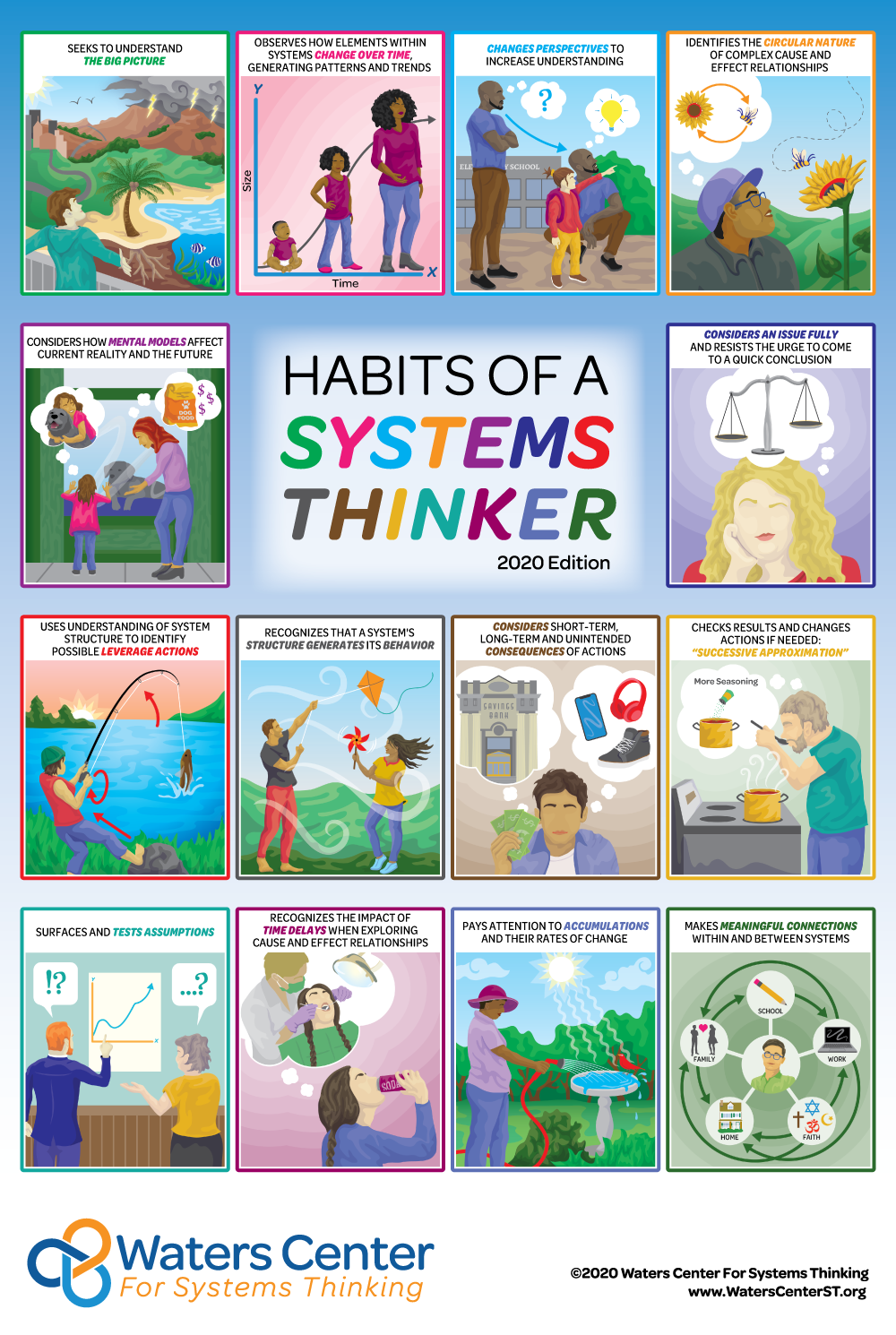
The framework below is a Working Out Loud attempt. It represents the first iteration of the Foundational Habits of a CAS Practitioner. While these habits are tailored specifically for navigating the unpredictable terrain of Complex Adaptive Systems, their DNA is deeply influenced by the pioneering work of the Waters Center for Systems Thinking (formerly the Waters Foundation). Much like the original Systems Thinking Habits, this set is designed to shift a practitioner’s mindset from linear mechanics to organic dynamics. However, this collection is specifically tuned for environments where agents are adaptive, cause-and-effect is only clear in hindsight, and emergence is the primary driver of change. Please note that this is a work in progress, an evolving “sense-and-adapt” document that reflects my ongoing learning from the field.

17 Foundational habits of a CAS practitioner
I. The dynamics (the physics of flow)
These habits tune our eyes to the reality of a non-linear world. They describe how the system moves, loops, and shifts before you even intervene.
1. Prioritise interactions over agents: The practitioner recognises that the distinctive behaviour of a complex adaptive system arises from the relationships and exchanges between agents, not from the agents in isolation. Practitioners look beyond individual people, teams, or components (“the dots”) and attend closely to the quality, frequency, and patterns of connections and information flows (“the lines”) that bind them.
2. Surface and work with feedback dynamics: They understand that systems are shaped by circular causality, where actions loop back to influence their origins, often with delays. Practitioners distinguish reinforcing loops (amplifying change) from balancing loops (stabilising or resisting). Actively surface hidden loops and work with their evolving dynamics rather than against them.
3. Discern patterns while questioning their permanence: They view observed trends and regularities as temporary dispositions of the system, not fixed laws. Practitioners continuously scan for weak signals of impending shifts, breaks, or reorganisations, avoiding the trap of over-extrapolating current patterns into the future.
4. Experiment to discover disproportionate effects: They anticipate that small, well-placed actions can sometimes trigger outsized effects, while large efforts may yield little or no change, but recognise this can only be known through interaction with the system. Practitioners use experimentation to uncover where modest interventions may cascade into meaningful systemic change, rather than assuming leverage can be identified in advance.
5. Listen to the “System Stories.”: The practitioner understands that in complex adaptive systems, narratives are the “connective tissue” of the system. They don’t just look at data points; they look at the anecdotes and myths circulating among agents. Practitioners recognise that shifting a system often requires changing the dominant narrative or “the way we talk about how things work here.”
II. The modalities (the practice of engagement)
This is our operational interface. It describes our specific modes of action: how we probe the system and navigate uncertainty.
6. Conduct safe-to-fail experiments: In contexts where cause and effect only become clear in retrospect, they replace rigid upfront planning with deliberate, low-risk probing. Practitioners design small, reversible interventions to test how the system responds, learn rapidly from outcomes, and scale or adjust before committing major resources.
7. Explore the adjacent possible: They avoid the pitfalls of forcing radical, unsupported leaps that the system’s current state cannot sustain. Practitioners Identify and enable the immediate next viable steps, changes that are already latent and feasible, fostering steady, evolutionary progress over disruptive overreach.
8. Match approach to context (The puzzle vs. The mystery): They recognise that linear, analytical methods suited to predictable domains fail when applied to living, unpredictable systems. Practitioners cultivate the habit of ontological inquiry, consistently asking: “Is this a puzzle to be solved (complicated) or a mystery to be lived (complex)?” before selecting a tool. They use structured engineering and expertise for complicated tasks where “best practice” exists, while deliberately shifting to iterative, probing approaches when facing genuine complexity and emergence, resisting the pressure to impose artificial certainty.
9. Embrace sense-and-adapt cycle: They treat strategy and decision-making as dynamic, ongoing processes rather than static plans. Practitioners act thoughtfully, closely observe the system’s real-time response, learn from it, and adjust the next move iteratively, maintaining agility in the face of evolving reality.
III. The architecture (the conditions for evolution)
This focuses on the “scaffolding” and the “levels.” We are managing the container and the constraints that allow healthy behaviour to emerge.
10. Cultivate and amplify emergence: They know that the most valuable properties of the system arise unpredictably from the bottom up, rather than being imposed from the top down. Practitioners stay vigilant for unplanned patterns and novel outcomes, treating them as signals of the system’s nature instead of anomalies to suppress.
11. Shape constraints and enabling structures: They accept that direct control of agents is illusory; instead, they influence behaviour by shaping the environment. Practitioners adjust boundaries (what is forbidden), incentives, and spaces (what is encouraged) to guide productive interactions naturally.
12. Prioritise resilience and evolvability over pure efficiency. They understand that relentless optimisation for a single outcome erodes the slack and diversity required for long-term survival. While efficiency seeks to eliminate waste in a stable environment, complex systems require “productive redundancy” to handle the unexpected. Practitioners deliberately protect adaptive capacity, maintaining buffers, diverse skill sets, and overlapping functions, so the system can not only absorb disturbances and recover (resilience) but also transform into something entirely new when the environment shifts (evolvability).
13. Attend to cross-scale dynamics: They recognise that systems are nested, with actions at one level rippling across others in both expected and unexpected ways. Practitioners consider how local changes interact with broader contexts, paying attention to alignments and misalignments between scales to avoid unintended consequences.
IV. The ethos (the human substrate)
This is the relational environment. These habits ensure the “agents” (the people) are capable of sensing, learning, and adapting together.
14. Triangulate perspectives: They remain aware that their own position inside the system creates inherent blind spots and biases. Practitioners actively gather diverse viewpoints and experiences from different agents to construct a richer, more reliable understanding of the system’s behaviour.
15. Practice radical humility: They acknowledge that complex adaptive systems are ultimately unknowable in full and resistant to complete mastery. Practitioners approach their role as a participant in an evolving process, staying curious, open to surprise, and willing to unlearn as the system changes.
16. Nurture diversity and heterogeneity: They recognise that variety among agents is a primary source of robustness, innovation, and adaptive potential. Practitioners actively protect and cultivate differences in skills and backgrounds rather than allowing convergence toward uniformity.
17. Foster psychological safety and trust: They understand that agents will only fully engage and experiment when they feel secure from undue blame or reprisal. Practitioners build conditions where people can voice dissent and admit errors, creating the foundation that makes safe-to-fail experiments and honest triangulation possible.
Closing the loop
This list isn’t the destination; it is my disposition. In a linear world, we look for a checklist to complete. In a complex adaptive system, we should look for a stance to take. These 17 habits represent my current “best fit” for navigating the messy, emergent reality of our work. But, true to Habit 3, I am questioning their permanence even as I write them.
As this is a “Working Out Loud” experiment, the most valuable part of the process is the feedback loop. Complex systems are best understood through multiple lenses (Habit 14), So I’m curious:
- Which habit feels most counter-intuitive in your current environment?
- Where is the tension between these habits and your existing “efficiency-first” structures?
- What is missing from the “lines” between these points?
Want help putting this into practice?
For You: Leadership Clinic
Bring the complex, unpredictable situation you are trying to navigate with tools built for linear problems. I prepare beforehand, then we spend 90 focused minutes building the sense-and-adapt habits that work when cause and effect are only clear in hindsight.
For You: Executive Coaching
For complexity that keeps resurfacing in different forms across your role. Work with me over time to build the systems-thinking habits that let you navigate emergence and adaptive agents rather than forcing linear plans onto them.
For Your Organisation: Building Complexity-Ready Teams
Bring me in to help your people develop the habits of a complex adaptive systems practitioner, so they can sense and adapt rather than over-plan for a world that will not sit still.
Choose the level of support that fits what you are working through.


Leave A Comment