
Hope is not a soft sentiment; it is a high-performance decision system. In boardrooms dominated by the language of certainty and control, hope is often dismissed as a “soft” luxury. This is a strategic failure. According to global Gallup research, hope is the #1 psychological need employees have from their leaders, accounting for over 50% of the attributes associated with positive leadership, far outstripping trust or stability. When uncertainty peaks, hope becomes a core leadership capability. Without it, creativity narrows and effort collapses, not due to a lack of skill, but because your team no longer believes their actions will change the outcome. Drawing on the behavioural science of C.R. Snyder and Albert Bandura, this article outlines the three-pillar cognitive architecture required to move a team from “learned helplessness” to sustained agency.
How can I as a leader build hope in my team?
Recent Gallup research across 52 countries shows that hope is the #1 psychological need followers have of their leaders. As shown below, it accounts for more than half of all attributes associated with positive leadership, far outstripping trust, compassion, or stability.
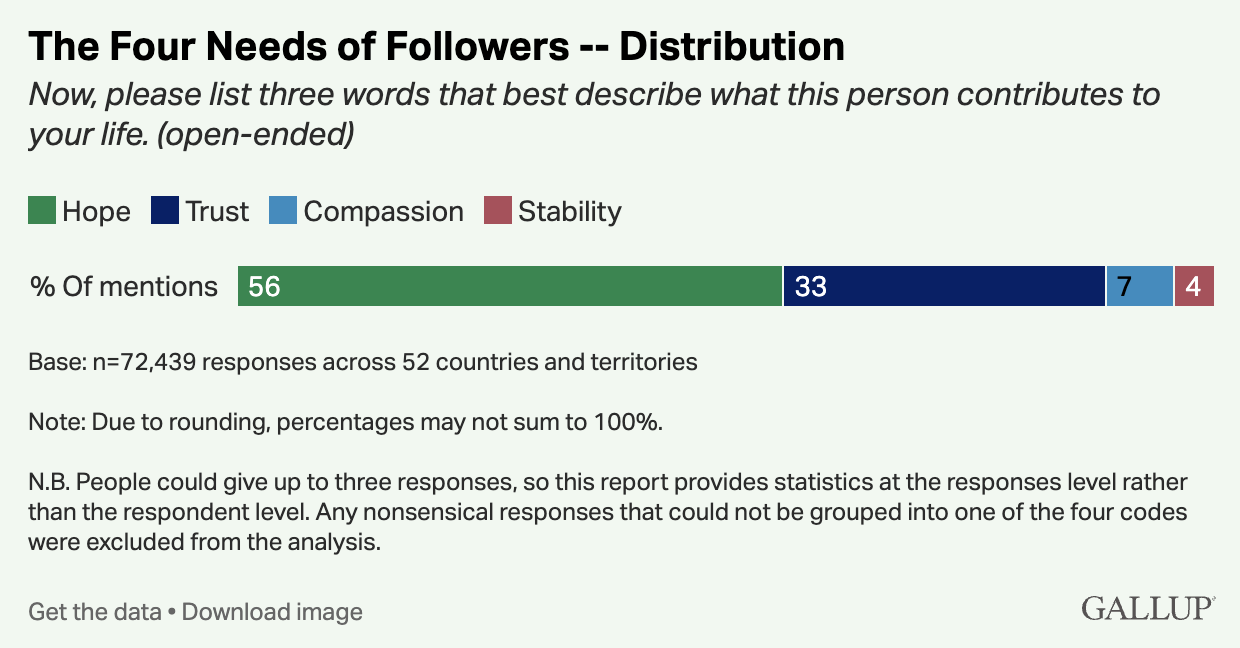
Image Source: Gallup (https://www.gallup.com/workplace/655817/people-need-leaders.aspx)
The implication is clear:
Across 72,000+ responses, people look to leaders not just for a steady hand, but for a sense of possibility. Trust and stability keep a team together, but only hope keeps them moving forward. Without it, effort collapses, not due to a lack of skill, but because the team no longer believes their actions will change the outcome.
The cognitive architecture: Snyder’s three pillars
- Goals (The Anchor): Hope requires a future that is both meaningful and specific. In an organisational context, goals are often either too abstract (“be the best”) or too fragmented. Without a clear goal, the brain experiences cognitive friction. Clarity reduces this load, allowing the individual to anchor their effort to a tangible outcome.
- Pathways (The Map): This is the “way-power.” Hope is high when an individual can see multiple routes to a goal. If a leader insists on a single, rigid plan, any obstacle becomes a terminal blockage. High-hope leaders encourage “pathway thinking”, the ability to generate alternative routes when the primary one is compromised.
- Agency (The Engine): This is the “will-power”, the belief that one’s actions actually matter. Closely aligned with Albert Bandura’s concept of Self-Efficacy, agency is the internal conviction that “I can do this.” Without agency, goals and pathways are academic; the individual sees the map but doesn’t believe they have the fuel to drive the route.
How leaders can design for hope
1. Translate ambition into visual milestones:
Hope begins with a future people can picture. Move beyond slogans and translate strategic statements into relatable outcomes. Instead of saying “we will improve performance,” say “we will reduce response times from five days to one, and our customers will finally stop calling with complaints.” Clarity allows people to align their decisions without needing constant interpretation.
2. Cultivate “pathway thinking”: In complex environments, a single plan is a fragility. Leaders build hope by asking, early and often, “What other ways forward exist?” When you treat adaptation as a core part of the process, rather than a failure of the original plan, you reinforce the belief that there is always a route forward. This prevents the “learned helplessness” that occurs when people feel trapped by a failing strategy.
3. Protect and distribute agency: Agency is built through Mastery Experiences. People need to act, see the impact of that action, and learn from the result. Leaders unintentionally kill agency when they step in too early, solve problems others could solve, or confuse “control” with “effectiveness.” Agency grows when responsibility is pushed down and ownership is made explicit.
4. Make progress visible and frequent: Motivation is sustained by the perception of movement. In many organisations, progress is invisible because cycles are too long or recognition is reserved for the final “win.” Leaders must highlight “micro-wins”, learning, iteration, and partial completions. A team that can see movement is more likely to sustain effort; a team that cannot will eventually question if their effort is worth the cost.
5. Manage uncertainty through presence: You cannot eliminate uncertainty, but you can contain it. Silence from leadership is filled by the team’s worst-case assumptions. Leaders build hope by clarifying what is known, admitting what is unknown, and setting short-term horizons. “What matters this week?” is often more hopeful than a 5-year plan because it provides a workable focus in a chaotic environment.
6. Use the language of possibility: Language shapes the shared meaning of work. Phrasing that emphasises limitation or inevitability (“We have no choice”) narrows the team’s thinking. By contrast, language that acknowledges difficulty while leaving room for movement (“This isn’t working yet”) invites engagement. This isn’t about forced positivity; it’s about maintaining a stance of workability.
From strategy to practice
To move these concepts from the page into your next team meeting, consider these three tactical interventions:
-
The “Pre-mortem” for pathways: When starting a project, ask the team: “If this fails in six months, why did it happen?” This isn’t being negative; it’s building Pathways. By identifying obstacles early, the team develops alternative routes, preventing hope from collapsing when the first roadblock inevitably appears.
-
The 15% rule (Agency): Borrowed from Peter Block and Gareth Morgan, ask your team: “What is your 15%? What do you have the discretion to do right now without asking for further resources or permission?” This immediately triggers Agency. It stops people from waiting for the “system” to change and helps them realise they have the “will-power” to act within their own sphere.
-
The “done wall” vs. The “to-do list”: To make progress visible, maintain a “Done Wall.” We are biologically wired for a dopamine hit upon completion. Seeing a physical or digital pile of finished tasks counters “learned helplessness” by providing evidence that effort leads to progress.
What works in practice: radical transparency
In my experience assisting leaders, the most effective shift is radical transparency about the “unknown.”: Leaders often fear that admitting uncertainty will kill hope. It’s actually the opposite. When a leader says, “Here is what we know, and here is what we are still figuring out,” they reduce the team’s cognitive load. It makes the “Goal” feel more honest and the “Pathways” more experimental. People don’t need a leader to have all the answers; they need a leader who is looking at the same map they are.
The subtle shift: From motivation to conditions
Reflection questions for leaders
1. Clarity of direction: Am I describing a future that people can clearly see and connect their work to, or am I relying on language that sounds right but leaves too much open to interpretation?
2. Pathways and possibility: Where might our current approach be too rigid, and have I created enough space for alternative routes, experimentation, and adaptation?
3. Agency and ownership: Do people in my team genuinely believe their effort makes a difference, and where might my behaviour be unintentionally reducing their sense of ownership?
4. Progress and conversation: Am I making progress visible and creating the kinds of conversations that invite people to choose commitment, rather than simply comply with direction?
Recommended resources to explore
- “The Psychology of Hope” by C.R. Snyder: The foundational work for understanding hope as a cognitive process of goals, pathways, and agency.
- “The Answer to How is Yes” by Peter Block: A masterpiece on challenging the “culture of dependency” and inviting genuine ownership.
- “The Progress Principle” by Teresa Amabile and Steven Kramer: The definitive resource on how “micro-wins” and visible movement drive sustained effort.
- “Self-Efficacy: The Exercise of Control” by Albert Bandura: The gold standard for understanding how to build the internal conviction required for action.
Do you have any tips or advice for helping people, teams or organisations gain hope?
What has worked for you?
Do you have any recommended resources to explore?
Thanks for reading!
Want help putting this into practice?
For You: Leadership Clinic
Bring the team that has stopped believing their effort changes the outcome. I prepare beforehand, then we spend 90 focused minutes building the goals, pathways and agency that turn learned helplessness back into hope.
For You: Executive Coaching
For a team whose hope keeps eroding under uncertainty in different ways. Work with me over time to build the cognitive architecture of goals, pathways and agency that sustains real hope rather than forced positivity.
For Your Organisation: Building a Hopeful Team Culture
Bring me in to help your leaders build hope as a core leadership capability, grounded in the behavioural science of goals, pathways and agency, rather than treating it as a soft extra.
Choose the level of support that fits what you are working through.


Leave A Comment