
Executive Summary:
In Inviting Leadership, Daniel Mezick and Mark Sheffield argue that the industrial age of “push” management is well and truly over. In a modern economy driven by clever ideas and rapid change, you simply cannot force a person to be brilliant. High-level cognitive work and the ability to solve “wicked” problems are voluntary gifts that an employee chooses to give. You can buy a person’s presence from nine to five, but you cannot buy their “A-game” through coercion.
To unlock this potential, leaders must stop acting like chess masters moving passive pieces and start acting as game designers or gracious hosts. They must build “Game Boxes” which are high-trust, structured environments where people feel safe enough to opt in and tackle the organisation’s most difficult challenges.
The problem with the chess master mindset
Many traditional managers fall into the trap of playing “Human Chess.” They treat their staff as inanimate objects to be shifted across a board to meet a quarterly goal. This approach is fundamentally flawed because humans are not pawns. When people feel moved or manipulated, they instinctively protect themselves. They stop taking risks, they stop sharing unconventional ideas, and they retreat into “malicious compliance,” which is the act of doing exactly what is told even when they know the plan is failing.
The game box and the magic circle
Instead of controlling people, the inviting leader designs the “Game Box.” Think of the difference between a boss barking orders and a game designer creating a world. A game like football or chess works because it has clear boundaries, a specific goal, and a set of rules that everyone agrees to follow. Within those lines, the players are entirely free to use their own ingenuity to win. In design theory, this is known as the “Magic Circle.” It is a psychological space where people agree to set aside their usual distractions because the challenge itself is rewarding. By defining the “win state” and the “rules of play,” a leader creates a sandbox where people actually want to show up and give their best.
The leader as a gracious host
If the organisation is a Game Box, the leader’s primary role is that of a host. A brilliant host does not tell their guests what to talk about or how to sit. Instead, they curate the environment to ensure the best possible outcomes. They provide “clean questions” to spark engagement, they manage the boundaries to keep the space safe, and they ensure that every person present has a reason to be there.
A host’s power is subtle yet profound. They lead through invitation rather than mandate. By inviting a colleague to a project rather than assigning it to them, you acknowledge their agency and respect their professional standing. This simple act of respect is often the catalyst that transforms a disengaged employee into a passionate contributor.
Why safety is a commercial necessity
In this framework, psychological safety is not a “soft” HR initiative; it is a hard requirement for high performance. If a person fears a telling-off for making a mistake, they will never innovate. The “Safety Stack” is the foundation of the Game Box. It ensures that everyone knows the rules and understands that opting out is a valid choice. When people know they won’t be punished for speaking their mind, they redirect their “cognitive load” away from self-preservation and towards solving the company’s biggest problems.
The Shift to distributed authority
Ultimately, Inviting Leadership is about increasing the “clockspeed” of an organisation. When authority is held at the top, decisions are slow and often based on outdated information. By “holding the rim” of the circle and authorising others to act within their own containers, the leader reduces decision latency. The organisation becomes a living system that can sense and respond to the market in real time, driven by the power of voluntary participation and genuine ownership.
10 Human-centred takeaways
1. Invitation beats instruction
You can’t command passion or creativity. When you order someone to “be innovative,” their brain often treats it like a threat, which actually shuts down high-level thinking. When you invite someone, you’re acknowledging their agency. You’re saying, “I need your unique brain for this.” That shift from “have to” to “want to” changes everything.
2. The power of “No”
True commitment only exists if “No” is a valid option. If people are forced to participate, you don’t get engagement; you get malicious compliance (doing exactly what they’re told, even if they know it’s wrong). By letting people opt out without being punished, you ensure the people in the room are actually there to win.
3. Be the “Chief Clarity Officer”
If you want people to join your mission, they need to know exactly what the mission is. Leadership is about signalling. If your signals are fuzzy, people stay on the sidelines. Your job is to tell a clear, honest story about where the company is going so people can decide for themselves if they want to be part of that story.
4. Design a “game” people want to play
Culture is just the “rules of the game” we play at work. To make it a good game, you need four things:
-
A Clear Goal: How do we know we won?
-
Simple Rules: What are the “out of bounds” markers (budget, ethics, etc.)?
-
A Scoreboard: Can the team see how they’re doing without asking a boss?
-
Voluntary Play: People follow the rules because they want to win the game, not because they’re afraid of the ref.
5. Give away the “right to decide”
Organisations move slowly because people are constantly waiting for permission. “Decision latency” is just a fancy way of saying “waiting for the boss to say okay.” To speed up, push the power to the people closest to the work. Don’t just delegate tasks; authorise people to make the call.
6. Treat meetings like a marketplace
Mandatory meetings are often a drain on the soul. If you make meetings optional, they become a “marketplace of value.” If no one shows up to your meeting, it’s a clear signal that the meeting isn’t useful. It forces you to get better at inviting people to things that actually matter.
7. Authority is a tool, Not a status
Authority is something you’re given (a title), but leadership is something you earn (a behaviour). An inviting leader uses their formal authority to “hold the rim”—protecting the team’s boundaries and making it safe for others to step up and lead.
8. Respect the “autonomy shield”
People don’t actually hate change; they hate loss of control. When you force change on people, their brains go into “survival mode.” When you invite them to help design the change, they become the architects of the future instead of its victims.
9. Be the host, not the hero
Think of a great dinner party. The host prepares the space, introduces the guests, and makes sure the drinks are full, but the host doesn’t do all the talking. In leadership, the host handles the environment (the container) so the guests can handle the work (the content).
10. Listen to the system
An organisation is a living thing. When people accept or decline invitations, they are giving you data. If a project is failing, don’t just blame the people, inspect the game design. Use the OODA loop (Observe, Orient, Decide, Act) to constantly tweak the environment until it’s a place where people can thrive.
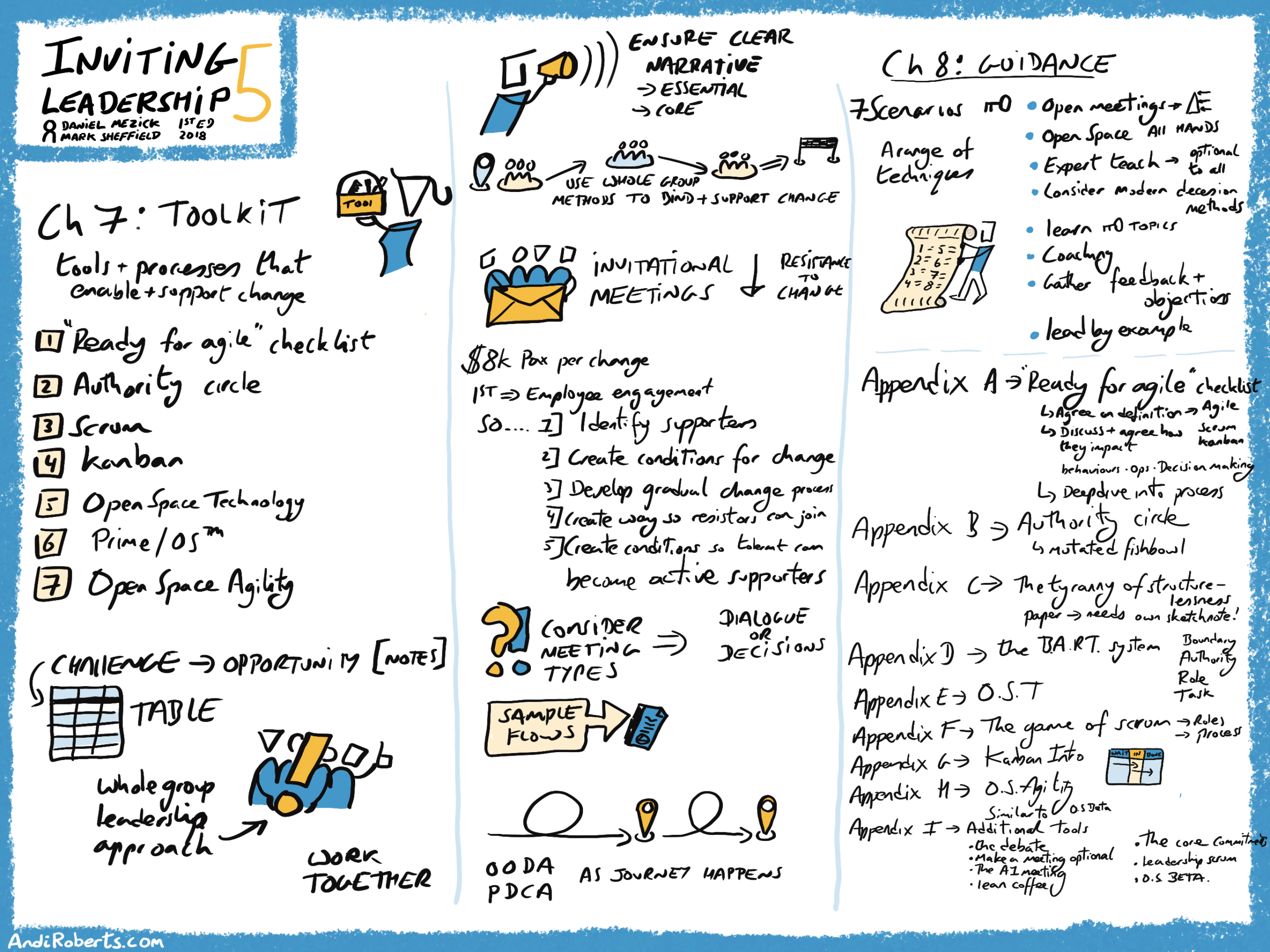
My 5 sketchnotes on Inviting Leadership
Here is my summary of the book in five sketchnotes:
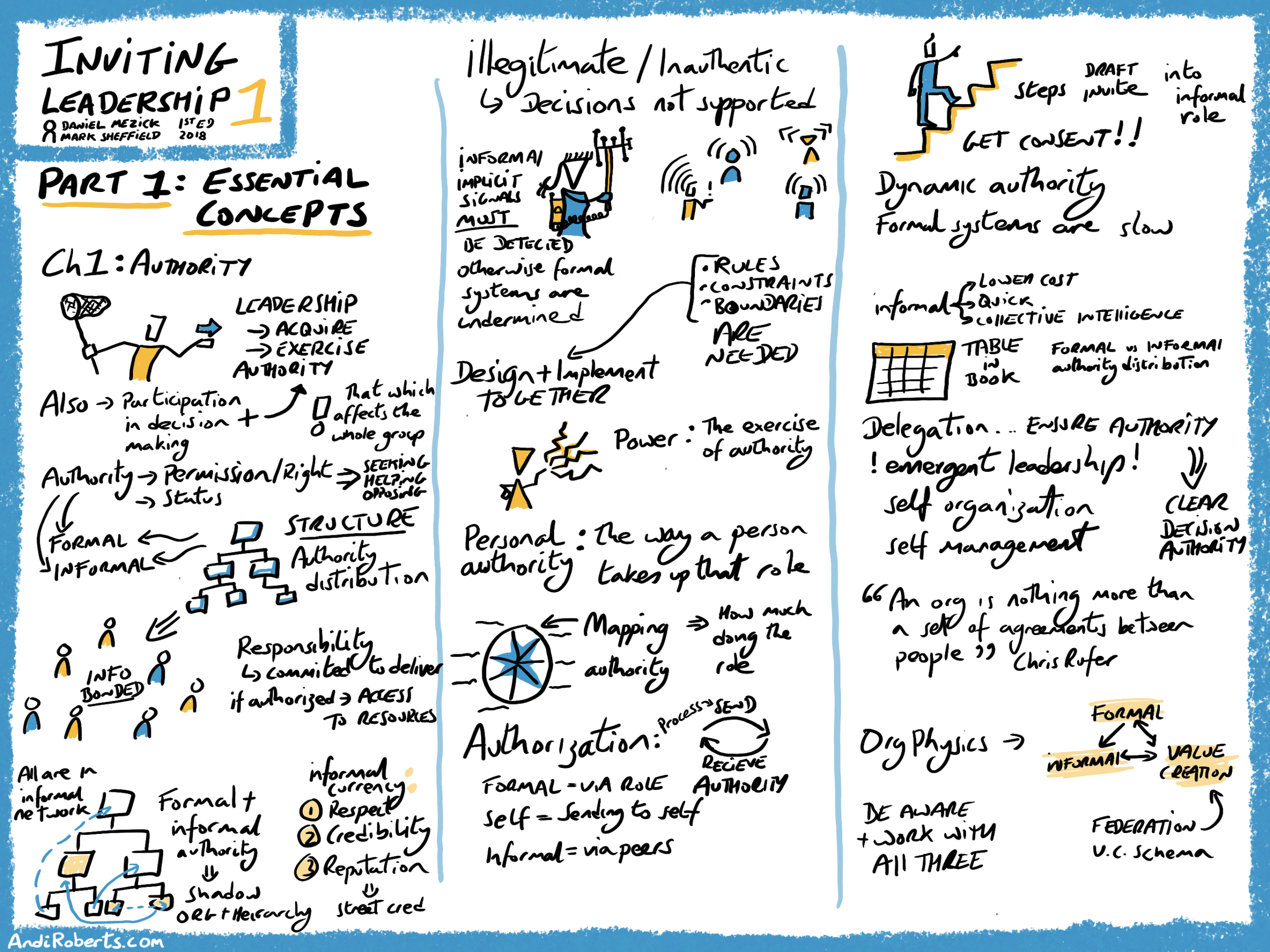
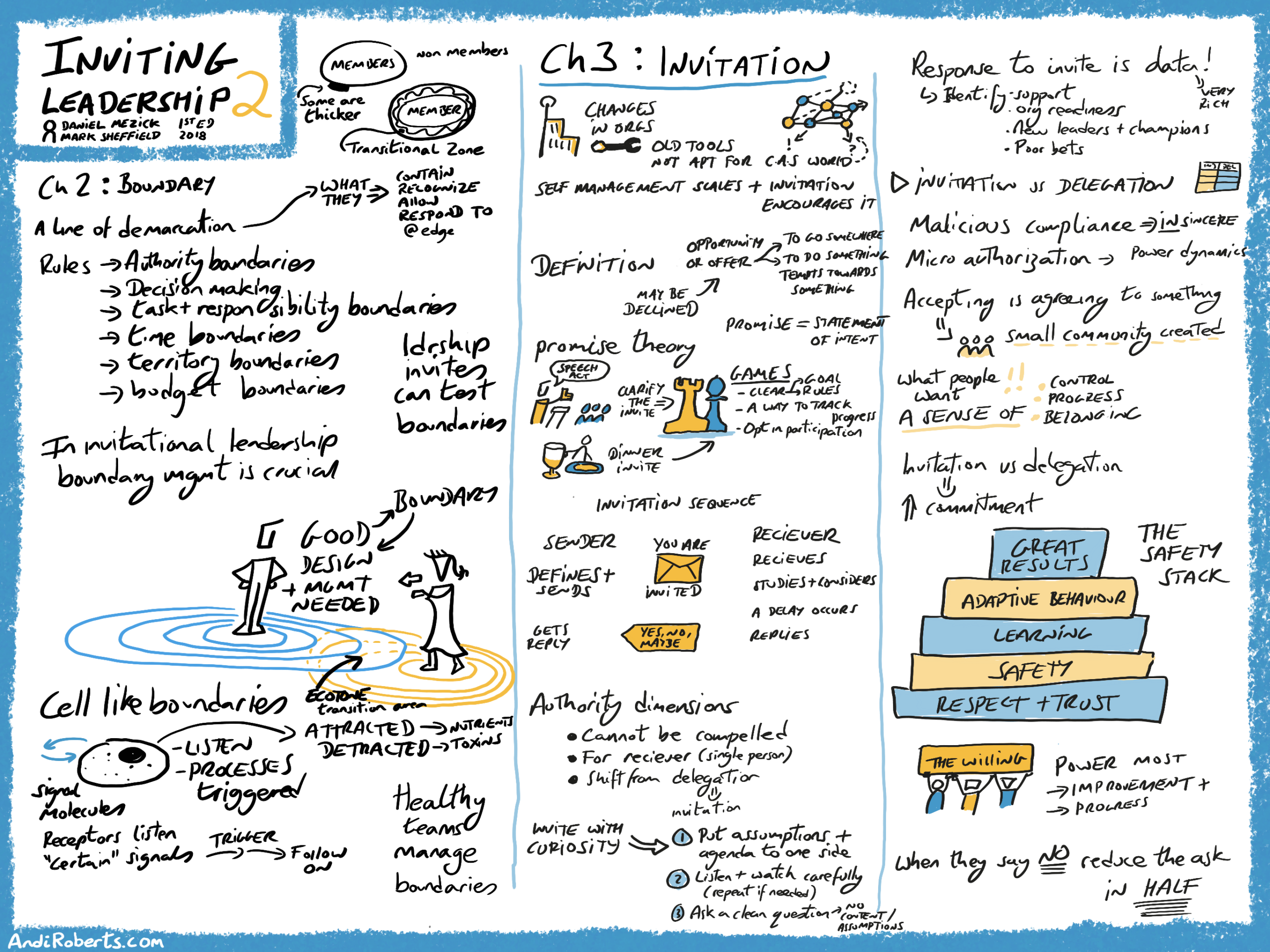
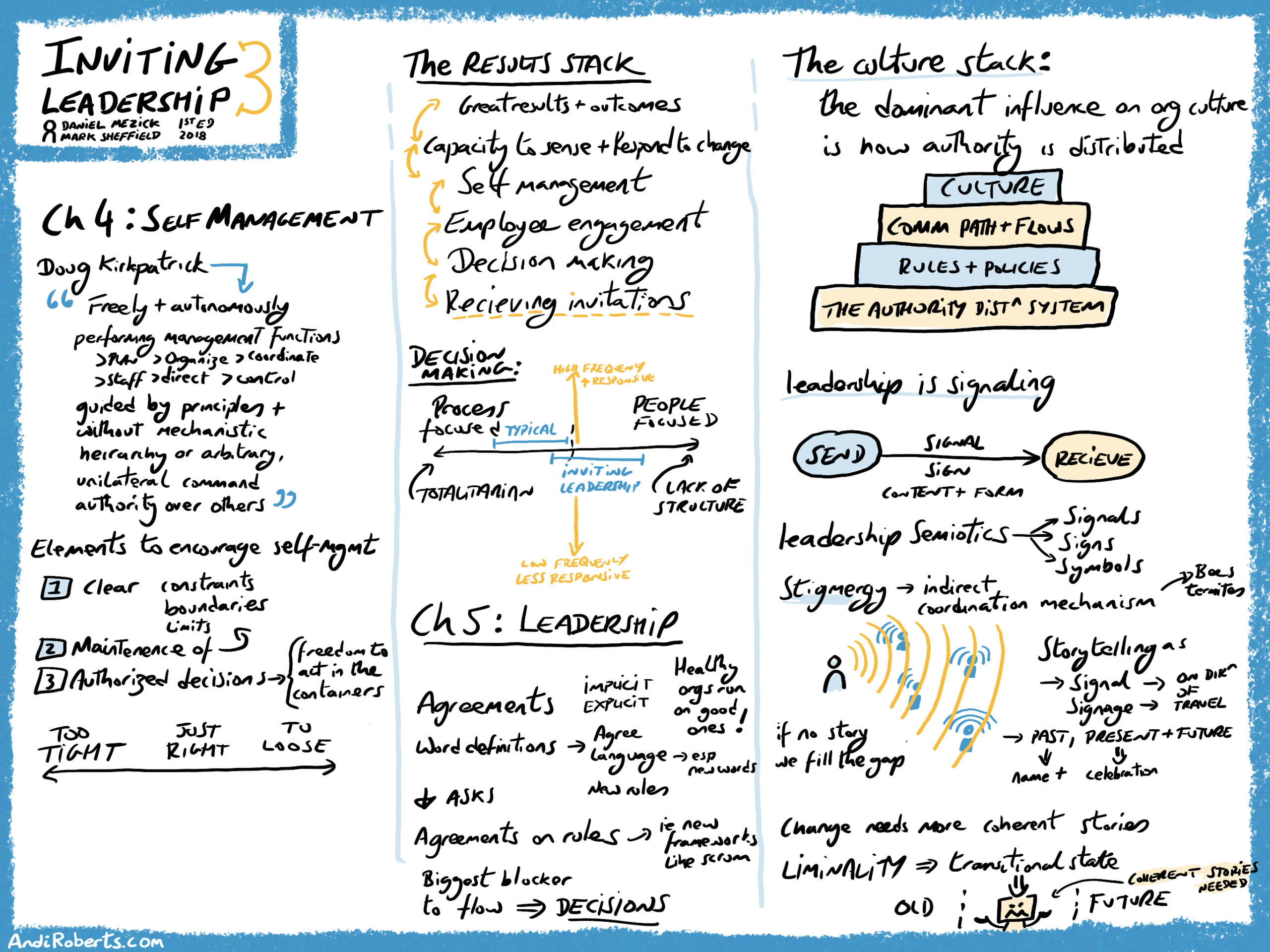
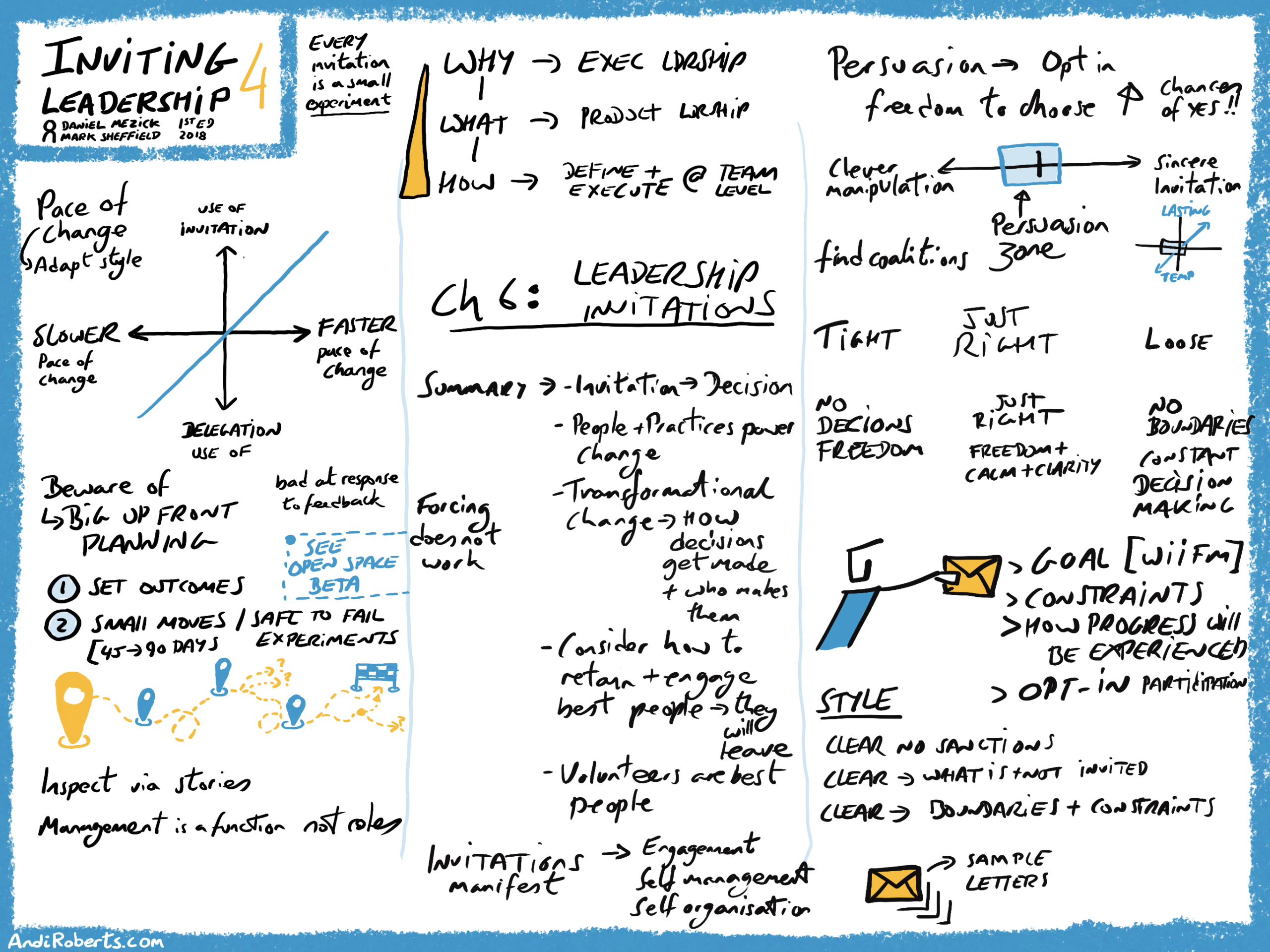
FAQ: Inviting Leadership book
How do I distinguish between a sincere invitation and clever manipulation?
Manipulation occurs when a “no” is not actually an option. If there are hidden sanctions, social shaming, or career penalties for declining, it is a command dressed as an invitation. A sincere invitation requires you to be emotionally detached from the “yes.” You must value the data provided by a “no” as much as the commitment provided by a “yes.” As seen in the sketchnotes, the “persuasion zone” lies between manipulation and sincere invitation; stay on the side of sincerity by being transparent about your intent.
What happens to my formal authority if everyone is “invited” to lead?
You do not lose your authority; you change how you exercise it. Your formal authority is used to “hold the rim” of the container. You use your power to define the game box, protect the team from external interference, and authorise others to make decisions. You are shifting from “power over” people to “power with” people. You remain the highest authority regarding the boundaries, even as you delegate authority over the content.
If participation is voluntary, how do I ensure the “boring but necessary” work gets done?
This is a design challenge. If no one opts into a necessary task, it usually means the “win state” is unclear or the task’s “rules” are too restrictive. In an invitational model, you share the “results stack” with the team. If the boring work is a prerequisite for the great results they want, the team will often self-organise to complete it. If they still refuse, it is a signal that the task may not be as “necessary” as you think, or that the current incentives are misaligned.
How do I handle “resistors” who refuse to opt in to anything?
In this framework, resistance is viewed as a functional response to a perceived threat. Instead of trying to “overcome” resistance, you investigate the boundary. A “resistor” is often someone protecting a value or a process they feel is being ignored. Use “clean questions” to understand their “no.” Often, reducing the “ask” by half or clarifying a specific boundary can turn a resistor into a supporter. If they never opt in, they eventually become “non-members” of that specific circle, which is a natural and healthy systemic outcome.
Is there a risk that “inviting” will make me look weak to my superiors?
The risk is real if you do not communicate the “clockspeed” benefits. Command and control looks “strong” but is actually slow and brittle due to decision latency. You frame your approach to your superiors as a strategy for “organisational physics.” You are building a system that senses and responds to change faster than any competitor. When you show that invitation leads to higher engagement and faster delivery, the “weakness” argument evaporates.
How do I design a “feedback system” that doesn’t feel like micromanagement?
The feedback must be for the players, not the coach. In a good game, the player sees the scoreboard and adjusts their own play. If you are the only one who sees the data and you then use it to “correct” people, you are micromanaging. If you make the data transparent and real-time (like a Kanban board or a burndown chart), the team self-corrects. Your role is to ensure the scoreboard is accurate, not to shout at the players.
What is the “liminal state” mentioned in the notes, and why is it dangerous?
Liminality is the “threshold” between the old way of working and the new. It is a state of “betwixt and between” where the old rules no longer apply but the new ones aren’t yet trusted. This state is highly creative but also highly anxious. Leaders must provide “coherent stories” during this phase to act as a compass. If you do not provide a clear narrative, people will fill the gap with fear and return to the safety of the old, command-based habits.
Can I use invitations for everything?
No. There are “non-negotiables” in every business, such as legal compliance, safety protocols, or core brand values. These are the “walls” of your game box. You do not invite people to follow the law; you command it. The art of inviting leadership is knowing exactly where the “walls” are and where the “open space” begins. Use your authority to set the walls and your leadership to invite people into the space between them.
How do I know if my organisation is “ready for agile” or invitation?
Check your “safety stack.” If there is no trust or respect, an invitation will be viewed with suspicion. You must first use your authority to establish safety. Use the “Ready for Agile” checklist from the toolkit to see if there is an agreement on definitions and a willingness to discuss how decisions are actually made. If the “formal” and “informal” systems are too far apart, you must bridge that gap first.
What is the most common mistake when starting this journey?
The most common mistake is “micro-authorisation”, giving people an invitation but then stepping in to make the decisions for them the moment things get difficult. This destroys trust instantly. When you issue an invitation, you must be prepared to live with the “guest’s” decisions within the rules you set. If you can’t trust the outcome, you haven’t designed the game box well enough yet.
What other books are worth reading on this topic?
OpenSpace Beta is the natural technical successor to Inviting Leadership. While Mezick and Sheffield introduce the concept of invitation, Hermann and Pflaeging provide a rigorous, 90-day blueprint for transforming an entire organisation from a traditional hierarchy into a “Beta” cell-structure. It is worth reading because it provides the systemic proof that organisations can function without top-down command. It introduces the concept of Very Fast Organisational Transformation (VFOT), which uses Open Space to “flip” the operating system of a company in a single, high-intensity move. If Inviting Leadership is the “Why” and the “How” of the individual leader, OpenSpace Beta is the “How” for the entire enterprise architecture.
Community by Peter Block’s is the philosophical and social foundation for the “Leader as Host” mindset. Block argues that strong communities (and by extension, strong organisations) are built through the power of the small group and the quality of the invitation. It is worth reading because it teaches leaders how to shift from “fixing” people to “creating a space” for them to be accountable. Block provides a specific set of “Six Conversations” that move people from a state of entitlement or rebellion to a state of ownership. His focus on the structure of belonging perfectly complements the safety stack and authority distribution concepts in shared in my sketchnotes. It reminds leaders that the most powerful thing they can do is change the nature of the questions they ask and the way they invite people into a room.
Want help putting this into practice?
For You: Leadership Clinic
Bring the team you are still trying to move like chess pieces. I prepare beforehand, then we spend 90 focused minutes redesigning how you invite commitment and build the high-trust conditions people opt into rather than comply with.
For You: Executive Coaching
For a leadership style that keeps defaulting to push and command under pressure. Work with me over time to build the game-designer mindset and the structures that invite people’s best work rather than demand it.
For Your Organisation: Building Invitation, Not Command
Bring me in to help your leaders move from command and control to designing the high-trust Game Boxes where people choose to bring their best thinking.
Choose the level of support that fits what you are working through.


Leave A Comment