
March 2026 Update: This summary has been fully updated to include the core shifts and new chapters from the 3rd Edition of Community. I have included a comparison of the new index and the two book covers below
What’s new in the 3rd edition (Updated 2026)
The third edition of Community: The Structure of Belonging arrives in a world still grappling with fragmentation, ideological divides, and economic inequality. While the core framework, including the powerful Six Conversations, remains the heart of the book, this update incorporates fresh insights from decades of real-world application.
Key additions include:
- Virtual & hybrid belonging: A brand-new chapter on structures and protocols for creating genuine connection in virtual gatherings, addressing the challenges of digital isolation and hybrid workplaces.
- The creative economy & social capital: Fresh content exploring the relationship between belonging, the creative economy, and how social capital fuels authentic engagement.
- New stories and examples: Updated real-world cases demonstrating how community-building approaches can be more powerful than traditional policies and programs for solving social problems.
- Expanded tools for practice: A new discussion guide plus additional resources designed for classrooms, training programs, book clubs, and leadership facilitators.
- New closing chapter: Broader implications of the ideas for organizational transformation.
The text has also been streamlined throughout for greater clarity, with chapter summaries added to make the key concepts even more accessible.
The 3rd edition (2026) content:

The older 2nd older edition content:

Why Community matters even more in 2026
The original ideas in Community haven’t just aged well; they’ve become more necessary. When Peter Block first wrote this, the world was already fragmented, but today that feels like an understatement.
Many leaders I talk to are hitting the same walls:
-
Digital distance: Hybrid and remote work have made “belonging” feel like a luxury rather than a given.
-
The limits of control: We’ve realised that you can’t actually force a culture or manage a community into existence.
-
Complexity: Our problems are too big for any one “hero leader” to solve from the top down.
The core shift Block’s message is that real change isn’t a technical problem to be solved; it’s a social one. It happens when we stop treating people as “problems to be fixed” and start inviting them to be “citizens” of the organisation.
For anyone facilitating groups or leading teams, this requires a fundamental shift in how we show up:
-
From managing performance to designing environments where people want to belong.
-
From driving alignment to hosting the kind of conversations that actually matter.
-
From fixing what’s broken to finding and building on the gifts that are already there.
The book in 3 sentences
The core idea is that without a shift in trust, social capital, belonging, and relatedness…our capacity to solve problems, organise work effectively, or end the suffering around us is greatly diminished. Genuine transformation arises when everyone connected to the situation shows up, trusts each other and decides how to make things better…the possibilities we have. Through a series of questions, asked in an engaging environment, we can fully engage the spirits of all to inspire the changes we wish to see in our teams, businesses or community.
Who should read it
-
Leaders and facilitators designing inclusive, participatory community experiences.
-
Organisational change agents seeking to shift culture from compliance to commitment.
-
Community developers and social entrepreneurs working to build engagement at a local level.
-
Coaches, educators, or conveners who want to deepen trust and ownership in groups.
Top 3 quotes
“The transformation we seek occurs when these two conditions are created: when we produce deeper relatedness across boundaries, and when we create new conversations that focus on the gifts and capacities of others.” – This quote captures the central practice of community-building: restoring connection across differences and reframing dialogue around strengths, not deficiencies. Transformation is not a technical task, it is relational. The act of reaching across traditional divides and seeing others through the lens of their gifts is what makes real change possible.
“The context that restores community is one of possibility, generosity, and gifts, rather than one of problem-solving, fear, and retribution. A new context acknowledges that we have all the capacity, expertise, and resources that an alternative future requires. Communities are human systems given form by conversations that build relatedness. ” – The scarcity mindset that dominates many organisations and institutions is its biggest barrier. Instead of focusing on deficits, Peter Block advocates for creating a culture of abundance, one that trusts in the latent capacity within the community itself. For him, community is not a place but a pattern of conversation, one that turns attention toward shared possibility and deeper human connection.
“We are owners of every issue that faces us. We need to be willing to answer “How have I contributed to creating the current reality?” This question is core to Community. Innocence or indifference are subtle denials of ownership.” – Ownership is one of Peter Block’s six key conversations, and this quote gets to the heart of it. Rather than blaming systems or external forces, Block asks us to consider our own role, however small, in shaping the world we inhabit. He frames disengagement not as neutrality but as avoidance, and calls for each of us to step into the discomfort of responsibility as a path to genuine belonging and change.
Top takeaways:
There are many, but here are the ideas that particularly stand out for me…
Moving from problems to possibility: Peter Block challenges the problem-solving mindset that dominates institutions and leadership. While problems matter, transformation happens when we move toward possibility. Instead of asking “What’s wrong and how do we fix it?”, Block encourages us to ask: “What future do we want to create together?” This shift is more than philosophical. It moves us from fear and fault toward generosity, gifts, and connection. As Peter Block says, we are choosing restoration over retribution and community over isolation.
The meaning of belonging: Belonging is not achieved through policies, but through design, dialogue, and shared ownership. It is central to addressing disconnection in society.There are three layers of belonging:
- To be part of something: Knowing “I am among friends.”
- To be an owner: Acting as a co-creator of the community.
- To long to be: Embracing presence and authenticity.
Leadership goes From Hero to Host: The role of leadership is not to fix but to convene. Traditional leadership relies on control, expertise, and solving problems. Leadership becomes an act of stewardship, caring for the social fabric of the community. Key elements are
• Hosting conversations that matter.
• Creating conditions for others to contribute.
• Attending to how people leave, not just how they enter.
• Prioritising depth over speed.
The small group as the unit of transformation: Transformation doesn’t happen through keynote speeches or mass emails, it happens in small groups. Block insists the small group is the core unit for building community. The process matters as much as the content. How we meet is how we build trust. Within small groups:
• Questions matter more than answers.
• Participants should mix with strangers, not friends.
• Reflection precedes sharing.
• Hospitality is intentional — welcoming the stranger.
Designing community engagement: Peter Block offers several design principles for facilitating community conversations:
• Use questions that challenge assumptions.
• Create circles of three to six people, mixing strangers.
• Sequence participation from individual reflection → trio → group of six → whole.
• Keep timing tight to encourage focus.
• Treat departures with care and dignity, as a model for belonging.
These are more than facilitation tips, they are ways to signal respect, welcome, and shared purpose.
Ownership, rewriting the story: A foundational conversation in Block’s work is ownership. Owning the narrative is the first step in shifting a culture. This involves:
• Examining the stories we tell about why things are the way they are.
• Identifying the payoffs of these stories, even if they hold us back.
• Asking what these stories cost us, and what we are willing to change.
Six conversations that create community – Block outlines six core conversations that make belonging real. These conversations are not linear; they are design elements for how we meet, speak, and decide.
-
Invitation – The act of asking, not mandating.
-
Possibility – Imagining the future without constraints.
-
Ownership – Acknowledging we are creators of our reality.
-
Dissent – Making space for ‘no’ as a form of engagement.
-
Commitment – Making promises with accountability.
-
Gifts – Naming the gifts of others and offering our own.
Peter mentions that there a range of ways to engage with these conversations. I have started t0 build out a page of Large Group Methods to build community that describes how to run these.
The power of gifts: Peter Block insists that community is built on gifts, not deficiencies. Too often we organise around what is missing. Instead, we should:
• Name and acknowledge the gifts each person brings.
• Make space for others to offer their gifts.
• Avoid professionalising help — we all have something to give.
The question is not “What do you need?” but “What gift do you have to offer?”
Peter, between the 2nd edition and this latest 3rd edition, wrote a few pieces that get introduced in this new version:
From Content to Connection looks at the connection being the content.
The Virtual hour explores how to have more productive online meetings.
Leader as convener explores the stance of collaborative leadership through the Community / 6 Questions lenses.
I have created based on Peter’s work a series of printable cards called 100 Acts on Connection, which was launched just prior to this Community 3rd Edition launch. They can be purchased HERE.
Peter, along with the Designed Learning faculty, which includes me, have also created two training offerings based around Community:
1) Leader As Convener Workshop: An interactive learning experience where participants discover how to lead conversations that foster belonging and transformation.
2) Leader As Convener Immersion Experience: A facilitated gathering within your organisation, designed to put the Six Conversations into action and address specific challenges.

Connected readings:
The Empowered Manager: This earlier work lays the groundwork for personal agency within bureaucratic systems. It introduces the concept of “entrepreneurial stewardship”, a precursor to the ownership and accountability themes developed more fully in Community.
Stewardship: Deepening the leadership thread in Community, Stewardship explores how leaders shift from control to service, redistributing authority and embodying the host posture needed to nurture belonging and co‑ownership in organisations.
The Answer to How Is Yes: A foundational piece that shapes the internal posture behind Community.it shifts our orientation from expertise and control to values and commitment, asking leaders to say “yes” to what matters before knowing “how.”
Flawless Consulting: The principles of effective consulting – contracting, authenticity, and feedback, mirror the convening skills Peter Block later applies to communities. It’s a bridge from professional expertise to civic engagement and shared responsibility.
Activating the Common Good: This book takes the six conversations and relational practices from Community and scales them to civic life, neighbourhoods, journalism, architecture, and public institutions, showing how to rebuild trust and social capital across public domains.
All my curated Peter Block content is now available on the Peter Block Resources hub page.
To buy the Third Edition of Community, buy from Peter Block directly HERE.
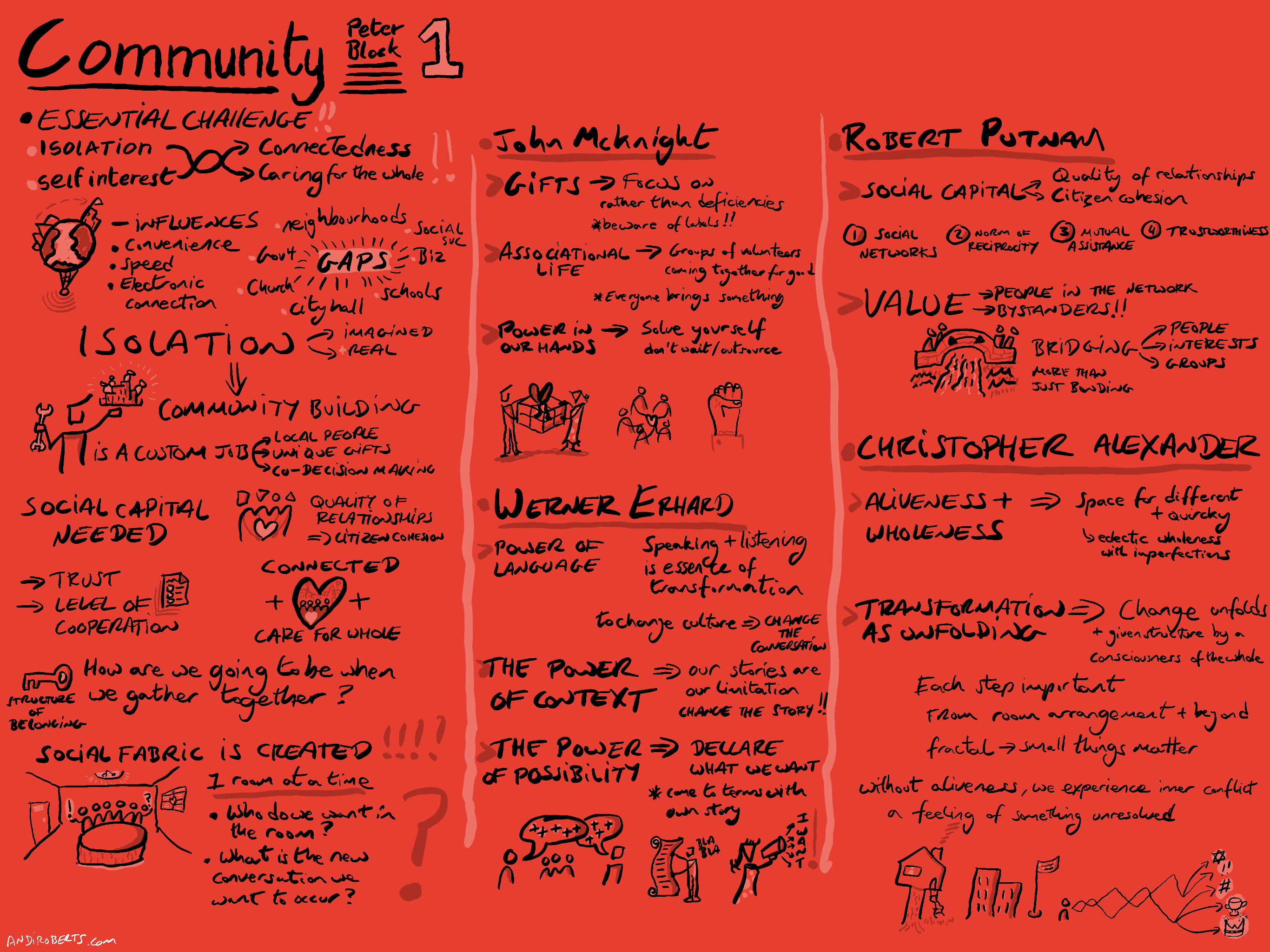
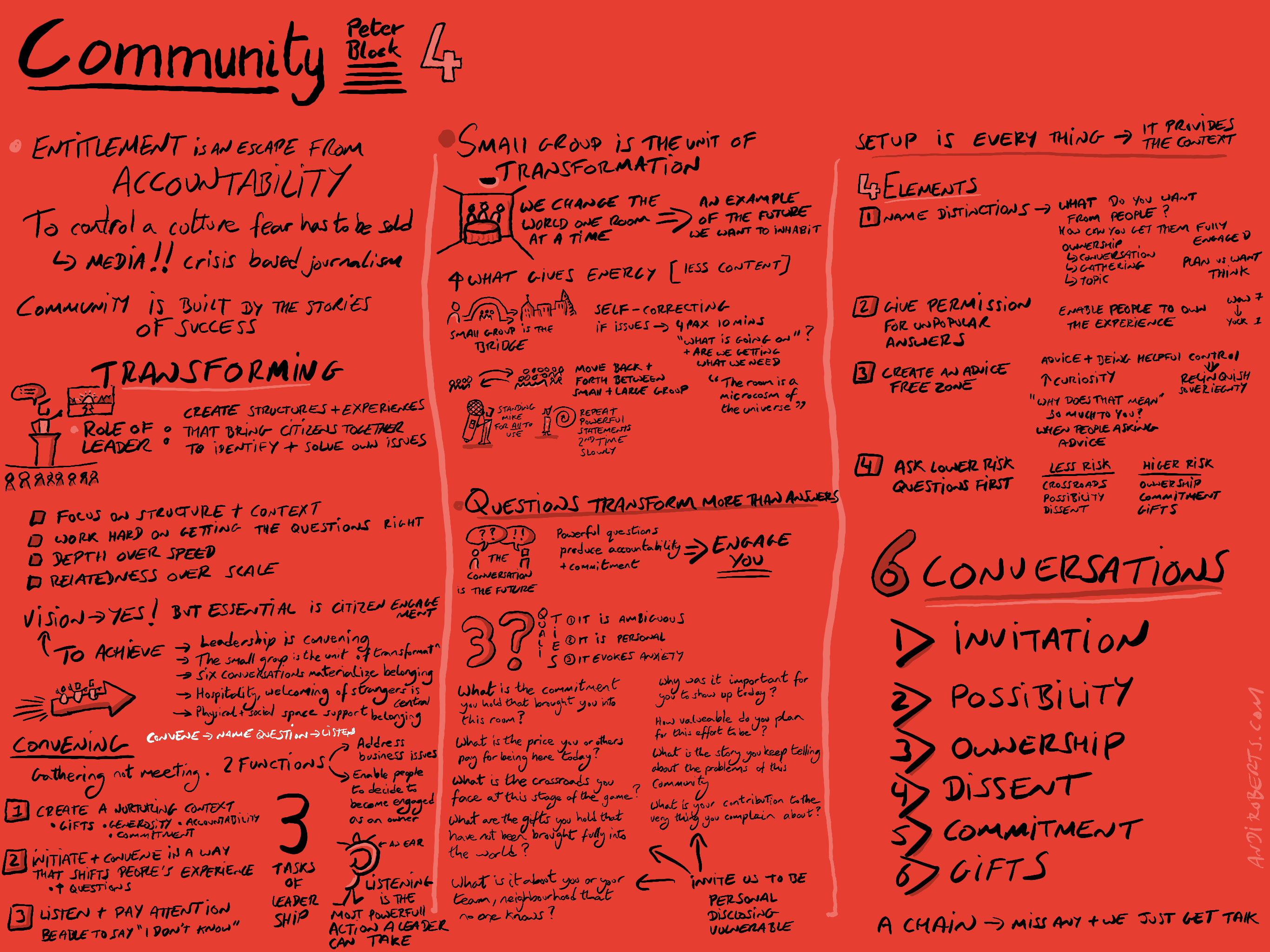
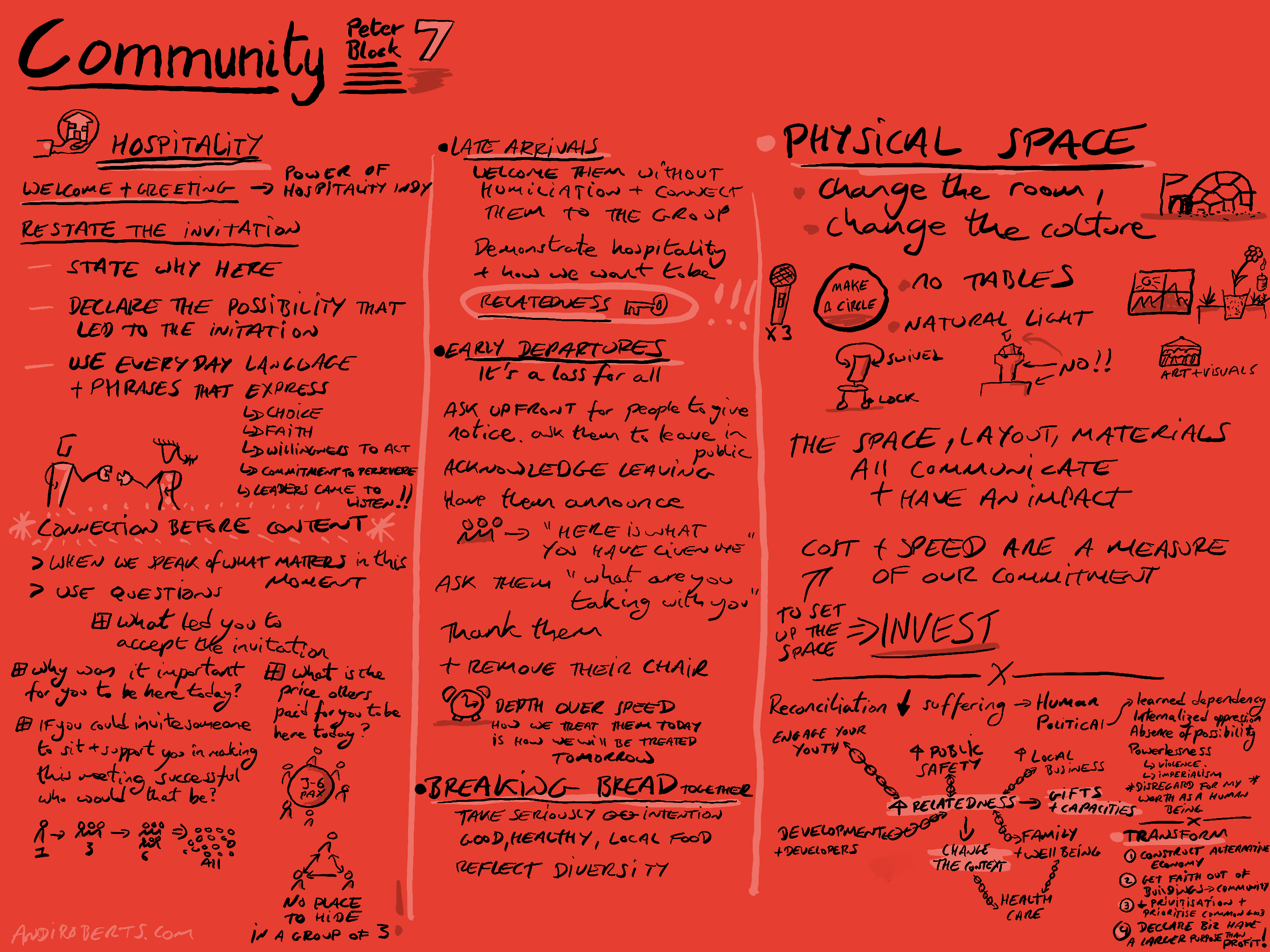
My quick visual notes:
Here are the notes I made as I reread the book, typically done on trains and planes:




Connection to my work:
As a leadership coach, facilitator and executive educator the book resonates with me due to the focus on asking powerful questions and getting leaders to reconnect to what is truly important and by creating change WITH the employees and other connected stakeholders. This book provides a solid process for co-created change in organisations and society as a whole. As an associate of Peter’s company Designed Learning, I am involved in delivering his work.
Updated for 3rd Edition on March 24th 2026 – Book launch date


Leave A Comment